All About Finding Cheap Botox Deals
August 1, 2026
Perk Up Your Peepers: The Non-Surgical Dysport Eye and Brow Lift
August 5, 2026
Everything You Need to Know About a Full Face Fibroblast Treatment
What Is a Full Face Fibroblast Treatment — and Is It Right for You?
A fibroblast full face treatment is a regenerative procedure that uses your own skin cells — called fibroblasts — to rebuild collagen, restore skin thickness, and reduce wrinkles and acne scars from the inside out.
Here’s a quick overview:
| Question | Quick Answer |
|---|---|
| What is it? | Injections of your own lab-grown skin cells into the face |
| How does it work? | Fibroblasts produce collagen and signal surrounding tissue to regenerate |
| How many sessions? | Typically 3 injections, spaced 4-6 weeks apart |
| When do results show? | Gradual improvement from 1 month; best results at 3+ months |
| How long do results last? | Up to 24 months, with no serious adverse events reported |
| Who is it for? | Adults with fine wrinkles, acne scars, or age-related skin thinning |
| Is it safe? | Yes — using your own cells means virtually zero risk of allergic reaction |
Unlike fillers that add synthetic volume instantly, fibroblast therapy works with your biology. Your cells are harvested, multiplied in a lab, and re-injected to do what they naturally do best — rebuild your skin’s foundation.
The results aren’t overnight. But clinical data shows they’re real, lasting, and meaningful. A Phase IIa clinical trial found that 90.1% of wrinkle sites and 86.1% of acne scar sites showed measurable improvement at six months — with results holding stable all the way to the 24-month mark.
This is regenerative medicine applied to facial rejuvenation. And it’s one of the most exciting developments in non-surgical aesthetics today.
I’m Abla Jad — as someone who built and scaled a multi-location healthcare business from the ground up, I’ve seen how transformative the right treatment can be when it’s grounded in real science, not just marketing. In this guide, I’ll walk you through everything you need to know about fibroblast full face therapy so you can make a confident, informed decision.
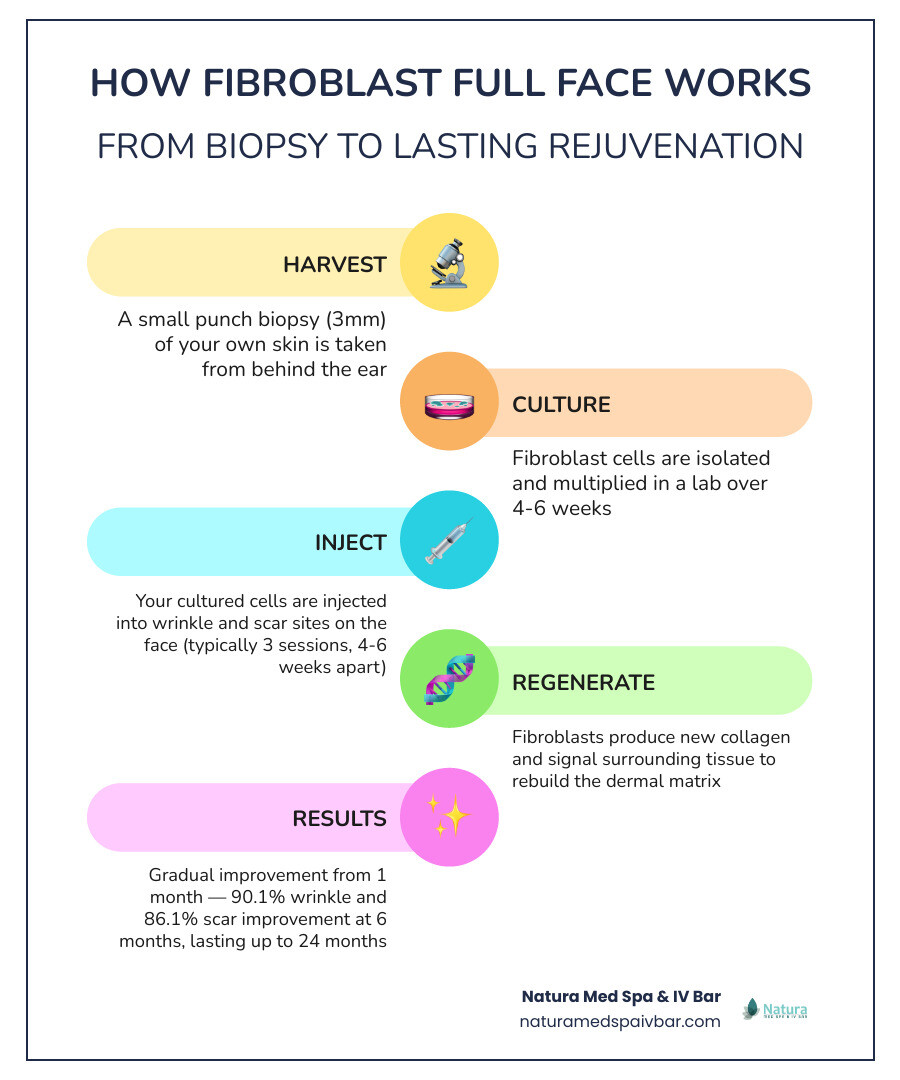
Fibroblast full face vocabulary:
The Science Behind Autologous Fibroblast Full Face Rejuvenation
To understand why a fibroblast full face treatment is so revolutionary, we first have to look at how our skin ages. In our youth, the dermis (the deeper layer of our skin) is packed with active fibroblasts. These industrious cells are the main engines responsible for producing collagen, elastin, and the extracellular matrix that gives our skin its bounce, thickness, and structure.
As we blow out more birthday candles, our native fibroblast population naturally declines, and the remaining cells become somewhat “sleepy.” This leads to a steady drop in collagen production, resulting in skin thinning, fine lines, structural sagging, and a loss of overall elasticity.
Autologous cultured fibroblast transplantation is a cutting-edge regenerative medicine technique designed to reverse this biological decline. “Autologous” simply means we are using your own cells. Instead of trying to stimulate your remaining, older cells with aggressive heat or injecting temporary synthetic gels, we harvest a tiny sample of your healthy skin, isolate the active fibroblasts, multiply them by the millions in a specialized laboratory, and transplant them back into your face.
Once re-introduced, these active cells don’t just sit there passively. They act as microscopic biological factories. They immediately begin synthesizing fresh, high-quality Type I and Type III collagen, restoring the structural integrity of your dermal matrix.
Furthermore, these transplanted cells communicate dynamically with your surrounding native tissues. This cellular signaling—often referred to as the “paracrine effect”—releases essential growth factors and cytokines that wake up your native skin cells, triggering a self-sustaining cascade of tissue regeneration.
If you are exploring ways to restore a youthful bounce to your skin, it is highly beneficial to compare skin tightening options to see how cellular therapies stack up against light-based, heat-based, or mechanical treatments.
Ideal Candidates for a Fibroblast Full Face Procedure
While autologous fibroblast therapy is a highly advanced treatment, it is not a one-size-fits-all miracle cure. Understanding who will benefit most is key to achieving satisfying, beautiful results.
The ideal candidate for a fibroblast full face protocol is someone experiencing:
- Age-related skin atrophy: Skin that feels thin, crepey, paper-like, or has lost its youthful “plumpness.”
- Fine lines and moderate wrinkles: Especially those dynamic and static lines around the eyes, forehead, mouth, and cheeks that do not require deep volume replacement.
- Atrophic acne scars: Depressed scars that have left the skin with an uneven, pitted texture.
- Loss of skin elasticity: Mild to moderate skin laxity where the skin has lost its ability to snap back quickly.
To understand how this fits into a broader aesthetic plan, you can learn more about non-surgical skin tightening options that target laxity through various medical modalities.
Contraindications to Keep in Mind: Like any medical procedure, there are situations where autologous fibroblast therapy is not recommended. Contraindications include:
- Active skin infections: Any active bacterial, viral (such as a herpes simplex outbreak), or fungal infection in the target treatment area.
- History of keloid scarring: Since the treatment involves micro-injections, patients prone to keloids or hypertrophic scars should proceed with extreme caution or avoid the treatment.
- Active cancer or history of cutaneous malignancies: Patients undergoing active cancer treatments or those with a history of skin cancer in the target areas are generally excluded.
- Deep structural volume loss: If your primary concern is deep facial hollows (such as severely sunken temples or cheeks) or significant sagging of the lower face, fibroblast therapy alone may not provide enough immediate structural lift. In these cases, it is often best paired with structural fillers or surgical options.
The Biological Mechanism of Action
To truly appreciate what makes this cellular therapy unique, we must look at the microscopic dance occurring beneath your skin. When we inject millions of cultured fibroblasts back into your dermis, we are initiating a profound change in the extracellular matrix (ECM).
Unlike synthetic fillers that simply push the tissue upward to mask a crease, transplanted fibroblasts physically integrate into the existing dermal architecture. Once they anchor themselves, they begin producing key structural proteins:
- Type I and III Collagen: The main structural proteins that provide tensile strength and firmness.
- Elastin: The protein responsible for the skin’s elasticity and “snap-back” quality.
- Glycosaminoglycans (including Hyaluronic Acid): The moisture-binding molecules that keep the skin hydrated and plump.
Beyond physical protein production, the “paracrine effect” is perhaps the most exciting part of this treatment. Injected fibroblasts act as cellular messengers. They release a cocktail of growth factors, including Transforming Growth Factor-beta (TGF-β) and Fibroblast Growth Factor (FGF). These signaling molecules travel to neighboring native cells, instructing them to increase their own metabolic activity and collagen production. This creates a highly collaborative, self-sustaining loop of tissue regeneration that continues long after the treatment sessions are complete.
Clinical Efficacy and Long-Term Durability of Fibroblast Therapy
When considering an advanced aesthetic treatment, you want to know that the science is backed by rigorous clinical data. Fortunately, autologous fibroblast transplantation has been evaluated in several landmark clinical trials.
A prominent Phase IIa clinical trial, evaluating the long-term safety and efficacy of autologous fibroblast transplantation for facial contour deformities, wrinkles, and acne scars, yielded impressive results over a 24-month period:
- At 6 months post-treatment: Evaluators noted that 90.1% of wrinkle sites and 86.1% of acne scar sites achieved at least a one-grade improvement on standardized clinical scales.
- Significant correction: Even more impressive, 56.1% of wrinkle sites and 63.9% of acne scar sites showed a two-grade or greater improvement at the 6-month mark.
- Patient perspective: The patients themselves were highly pleased, with 70.5% of wrinkle sites and 72.2% of acne scar sites rated as “good” or “excellent” in self-assessments.
- Unmatched durability: Most importantly, these clinical improvements remained remarkably stable up to 24 months post-treatment, with absolutely no serious adverse events reported.
These findings highlight that autologous fibroblast transplantation is not a temporary band-aid, but a long-term corrective modality. If you would like to read the clinical evidence yourself, you can explore the Long-Term Follow-up of Autologous Fibroblast Transplantation study on PubMed.
Patient vs. Physician Satisfaction and Study Limitations
An interesting phenomenon observed in clinical trials of regenerative medicine is the slight discrepancy between patient self-assessments and physician evaluations.
For instance, clinical data shows that:
- At 1 month post-treatment: 60.3% of patients rated the treatment as effective, while physicians evaluated 79.5% of cases as effective.
- At 3 months post-treatment: The efficacy ratings rose significantly for both groups, with 75.0% of patients and 92.0% of physicians rating the treatment as highly effective.
This statistical jump demonstrates that fibroblast grafting is significantly more effective at three months than at one month, showing statistically significant improvement in both patient evaluations (p=0.0123) and physician evaluations (p=0.0209).
Why the “Perception Gap” Exists: Why do doctors consistently rate the treatment’s efficacy higher than patients do in the early stages?
- 3D Harmony vs. Localized Focus: Patients tend to evaluate their faces in a two-dimensional hand mirror, focusing on specific, localized lines or scars. Physicians, on the other hand, are trained to evaluate the face as a dynamic, three-dimensional whole, noticing improvements in overall skin quality, light reflection, and facial balance.
- Gradual Onset: Because cellular remodeling takes time, patients may get used to their gradual, daily improvements and fail to notice how much their skin has actually changed until they are shown their baseline “before” photos.
Limitations of Current Studies: While the clinical data is incredibly promising, researchers acknowledge certain limitations in current literature. Many studies feature relatively small sample sizes, a lack of strict double-blind randomization, and a reliance on subjective visual grading scales. Future research with larger, multi-center randomized controlled trials will help establish autologous fibroblast therapy as a primary, first-line option for full-face rejuvenation.
The Treatment Protocol: Harvesting, Culturing, and Injection
Getting a fibroblast full face treatment is a multi-step journey that combines clinical expertise with advanced laboratory biotechnology. Here is what the standard protocol looks like from start to finish:
- The Donor Biopsy: We begin by harvesting a tiny, 3-mm punch biopsy of skin, typically from a discreet, sun-protected area behind your ear (the postauricular region). This procedure is quick, performed under local anesthesia, and requires only a tiny adhesive bandage.
- Laboratory Cultivation: The harvested tissue is immediately sent to a specialized, state-of-the-art laboratory. Here, the tissue is processed, and the dermal fibroblasts are isolated. Over the course of approximately six weeks, these cells are carefully cultured, expanded, and passaged in a controlled environment until they reach a therapeutic dose of approximately 40 million to 100 million cells.
- Quality Control: Before the cells are cleared for injection, they undergo rigorous testing for viability, sterile conditions, and morphological integrity.
- The Injection Session: Once your personalized cell suspension is ready, it is shipped back to our clinic. The cells are suspended in a sterile saline solution (typically 5 to 10 mL total volume) at a target concentration of 1-2×10^7 cells/mL. Using a ultra-fine needle (such as a 31G x 4mm needle), we perform precise, intradermal micro-injections across your entire face, focusing slightly more volume on your specific areas of concern.
- The Treatment Series: To achieve optimal, long-lasting results, the standard protocol consists of 3 injection sessions spaced 4 to 6 weeks apart.
What to Expect During a Fibroblast Full Face Recovery
One of the greatest benefits of utilizing your own biological material is the remarkably gentle recovery process. Because there are no foreign chemicals or synthetic materials being introduced, the body does not mount an aggressive inflammatory defense.
Typical Post-Treatment Timeline:
- Immediately After: You will experience mild to moderate redness (transient erythema) and localized swelling at the injection sites, resembling tiny mosquito bites. We will apply cold compresses for about 30 minutes post-treatment to soothe the skin.
- Day 1 to 2: The redness and swelling typically resolve within 24 to 48 hours. Some patients may experience minor pinpoint bruising or needle-mark purpura, which can easily be covered with mineral makeup starting the day after the procedure.
- Day 3 and Beyond: Your skin returns to its normal appearance, and you can resume all your regular skincare products and activities.
Compared to aggressive laser resurfacing, deep chemical peels, or surgical options, the downtime is virtually non-existent. However, keep in mind that the financial investment reflects the highly specialized laboratory culturing required. You can read about the real cost of fibroblast plasma treatments to better understand the pricing landscape of advanced skin tightening and regenerative services.
Comparing Fibroblast Therapy with Traditional Dermal Fillers
To decide if a fibroblast full face treatment aligns with your aesthetic goals, it is helpful to compare it directly with traditional, synthetic dermal fillers.
| Feature | Autologous Fibroblast Therapy | Traditional Hyaluronic Acid Fillers |
|---|---|---|
| Primary Mechanism | Cellular transplantation; stimulates natural collagen production | Synthetic gel that physically occupies space |
| Onset of Action | Gradual and progressive (visible at 1-3 months) | Immediate |
| Durability of Results | Long-lasting (stable up to 24 months or more) | Temporary (typically 6 to 12 months) |
| Risk of Allergic Reaction | Virtually zero (100% autologous) | Low, but possible (foreign body reaction) |
| Risk of Vascular Occlusion | Extremely rare/negligible | Present (if filler accidentally enters a blood vessel) |
| Natural Look & Feel | Exceptional (it is your own regenerated skin) | Excellent, but can look overfilled if overdone |
While traditional fillers are fantastic for patients seeking instant gratification or deep structural sculpting (like defining a jawline or building up cheekbones), they do not improve the actual health or cellular age of your skin. Fibroblast therapy, conversely, is an investment in your skin’s biological youth.
Combination Therapies: Fibrogel and Hyaluronic Acid Hybrids
What if you want the best of both worlds—immediate volume correction and long-term cellular rejuvenation? This is where modern combination therapies shine.
One of the most exciting innovations in this space is Fibrogel, a sophisticated autologous dermal filler that combines your cultured dermal fibroblasts with a plasma gel bioskeleton derived from your own blood.
Here is how it works:
- The Bioskeleton: Platelet-poor or platelet-rich plasma (PRP) is harvested from your blood and heated to create a natural, gelatinous gel.
- The Cell Mixture: Your cultured fibroblasts are mixed into this heated plasma gel (ensuring the temperature is safely below 37°C to protect the living cells).
- The Dual Effect: When injected, the plasma gel provides an immediate, natural-looking volume-filling effect. Meanwhile, the plasma gel acts as a 3D scaffold, keeping the transplanted fibroblasts densely concentrated in the target areas and nourishing them with native growth factors to accelerate their proliferation.
A clinical case report evaluating Fibrogel demonstrated excellent, instantaneous volume improvement that remained highly stable and beautiful at a 12-month follow-up. For a deep dive into this hybrid cellular technology, read the study on Autologous Dermal Filler Derived from Cultured Dermal Fibroblasts and Plasma Gel (Fibrogel).
Frequently Asked Questions about Fibroblast Full Face Treatments
Navigating advanced regenerative aesthetics can bring up a lot of questions. We believe in complete transparency and education. If you want to explore more common questions about our services, read our FAQs.
How long do the results of a full-face fibroblast treatment last?
Because autologous fibroblast therapy actually remodels the cellular structure of your dermis, the results are exceptionally durable. Clinical data shows that the improvements in skin thickness, wrinkle depth, and acne scars remain highly stable and effective for up to 24 months post-treatment. While your skin will continue to age naturally, you have essentially “turned back the biological clock” by repopulating your skin with highly active, youthful cells.
How does autologous fibroblast therapy differ from plasma pen treatments?
This is one of the most common points of confusion in medical aesthetics today!
- Plasma Pen (Fibroblast Plasma Lift): This is a device-based treatment that uses an electrical arc to create tiny, controlled superficial burns on the surface of the skin. This thermal trauma forces the skin to contract and stimulates a localized healing response. To learn more about this surface-level technology, check out the ultimate guide to cold plasma skin tightening.
- Autologous Fibroblast Therapy: This is a cellular transplantation therapy. There are no burns, no thermal trauma, and no electrical arcs. Instead, we are physically harvesting, multiplying, and injecting living cells back into your dermis to naturally rebuild the skin matrix.
Both have their place, but they are entirely different biological approaches to skin rejuvenation.
Are there any risks of allergic reactions with autologous fibroblasts?
No. Because the cells are harvested directly from your own body, cultured, and returned to you, there is virtually zero risk of allergic reactions, foreign-body rejection, or heterozygous reactions. It is the ultimate biocompatible treatment because it is 100% you.
Conclusion
The field of aesthetics is undergoing a massive shift away from temporary, synthetic fixes and toward natural, self-sustaining regenerative medicine. A fibroblast full face treatment represents the pinnacle of this movement—giving your skin the exact biological tools it needs to rebuild, repair, and rejuvenate itself from within.
Whether you are looking to smooth out fine lines, soften atrophic acne scars, or simply restore that firm, bouncy elasticity of your youth, cellular therapy offers a scientifically proven, incredibly safe, and long-lasting solution.
At Natura Med Spa & IV Bar, we are proud to serve our communities across Aurora, Denver, and Cherry Creek, Colorado, offering results-driven beauty and wellness treatments tailored to your unique biology. If you are ready to explore the future of cellular skin rejuvenation, we invite you to explore our non-surgical skin tightening services and schedule an educational consultation with our expert medical team today!