Everything You Need to Know About a Full Face Fibroblast Treatment
August 3, 2026
Shaving Away the Years: How Dermaplaning Tackles Dark Spots
August 7, 2026
Perk Up Your Peepers: The Non-Surgical Dysport Eye and Brow Lift
What a Dysport Brow Lift Can Do for a Tired, Heavy Brow
A Dysport brow lift is a non-surgical treatment that uses botulinum toxin type A injections to relax the muscles that pull your brows downward — letting the forehead’s lifting muscle raise them back up naturally.
Here’s a quick summary of what to know:
| What You Want to Know | The Short Answer |
|---|---|
| What it does | Relaxes depressor muscles to lift the brow without surgery |
| How it works | Targets corrugator, procerus, and orbicularis oculi muscles |
| Results timeline | Visible in 2–3 days, full effect by days 7–10 |
| How long it lasts | 3–4 months; maintenance every 12–16 weeks |
| Elevation achieved | A few millimeters — subtle but noticeable |
| Who should avoid it | Pregnant or breastfeeding patients, those with neuromuscular disorders or botulinum toxin allergies |
If you’ve been noticing a heavier, more tired look around your eyes, you’re not alone. Brow ptosis — the gradual drooping of the brow — becomes increasingly common after age 50, and it can make you look fatigued or even angry even when you feel fine. Over 10 million patients chose neuromodulator injections in 2024, and a growing number of those were specifically for brow lifting — no scalpel, no downtime, no permanent commitment.
I’m Abla Jad, and my background building and scaling a multi-location healthcare business gives me a practical, operator’s perspective on aesthetic treatments like the Dysport brow lift that goes beyond the clinical theory. That real-world lens shapes everything I share in this guide, so let’s get into what actually matters for your decision.
Understanding the Dysport Brow Lift Procedure
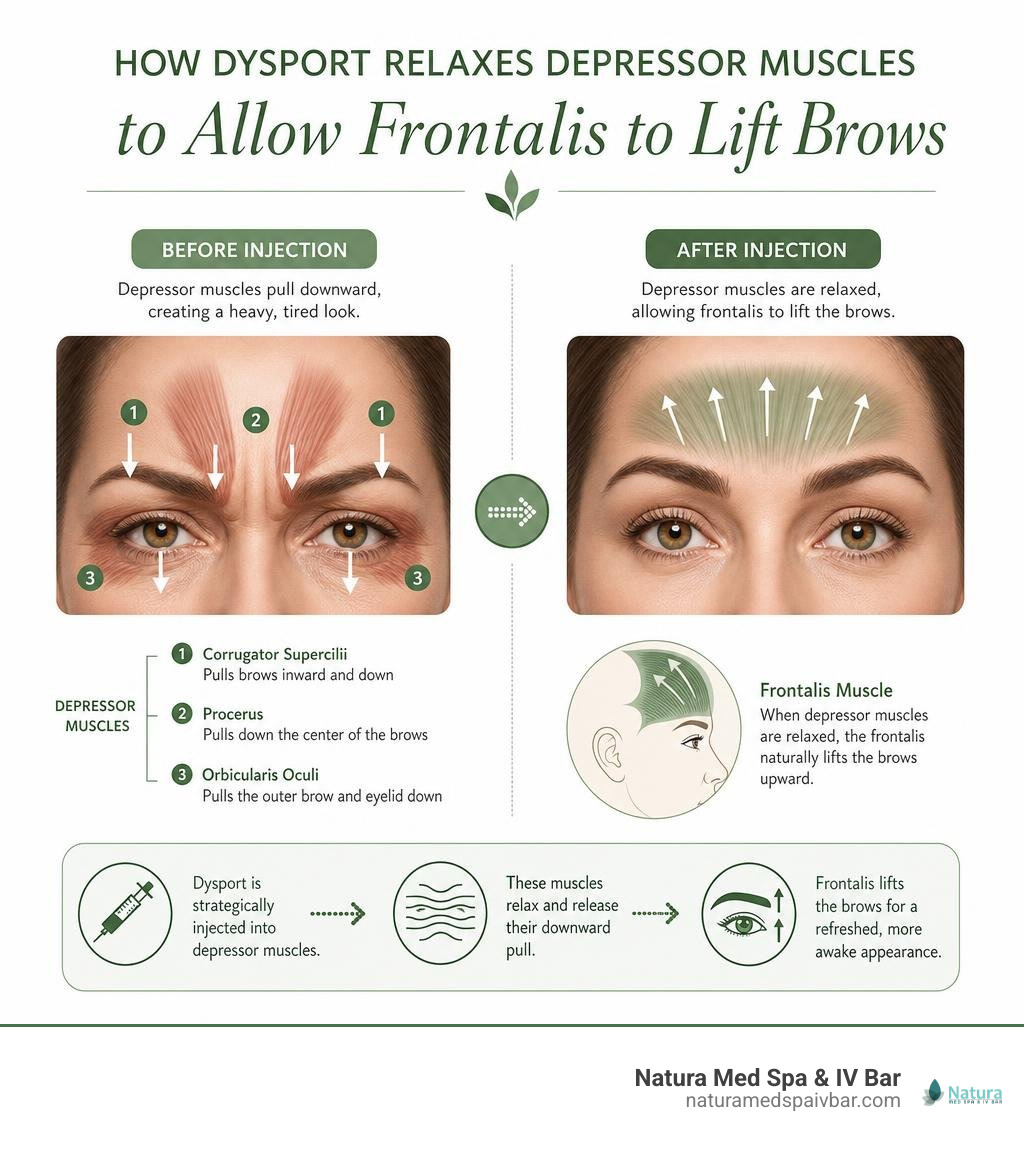
To understand how a dysport brow lift creates a refreshed, open-eyed look, it helps to understand facial anatomy. Your upper face relies on a delicate tug-of-war between two main groups of muscles: depressors (muscles that pull downward) and elevators (muscles that lift upward).
When we perform a chemical brow lift using Dysport injectables, our target is not the muscle that lifts your forehead, but rather the depressor muscles pulling everything down:
- The Glabella Complex: This group includes the corrugator supercilii muscles (which draw your brows together, creating vertical “11” lines) and the procerus muscle (which pulls the medial brow downward between your eyes).
- The Orbicularis Oculi: This circular muscle surrounds the eye. Its upper and outer (lateral) fibers pull the tail of the eyebrow downward every time you squint or smile.
- The Frontalis Muscle: This expansive muscle spans your forehead and is the only elevator muscle in the upper face. Its job is to pull the eyebrows upward.
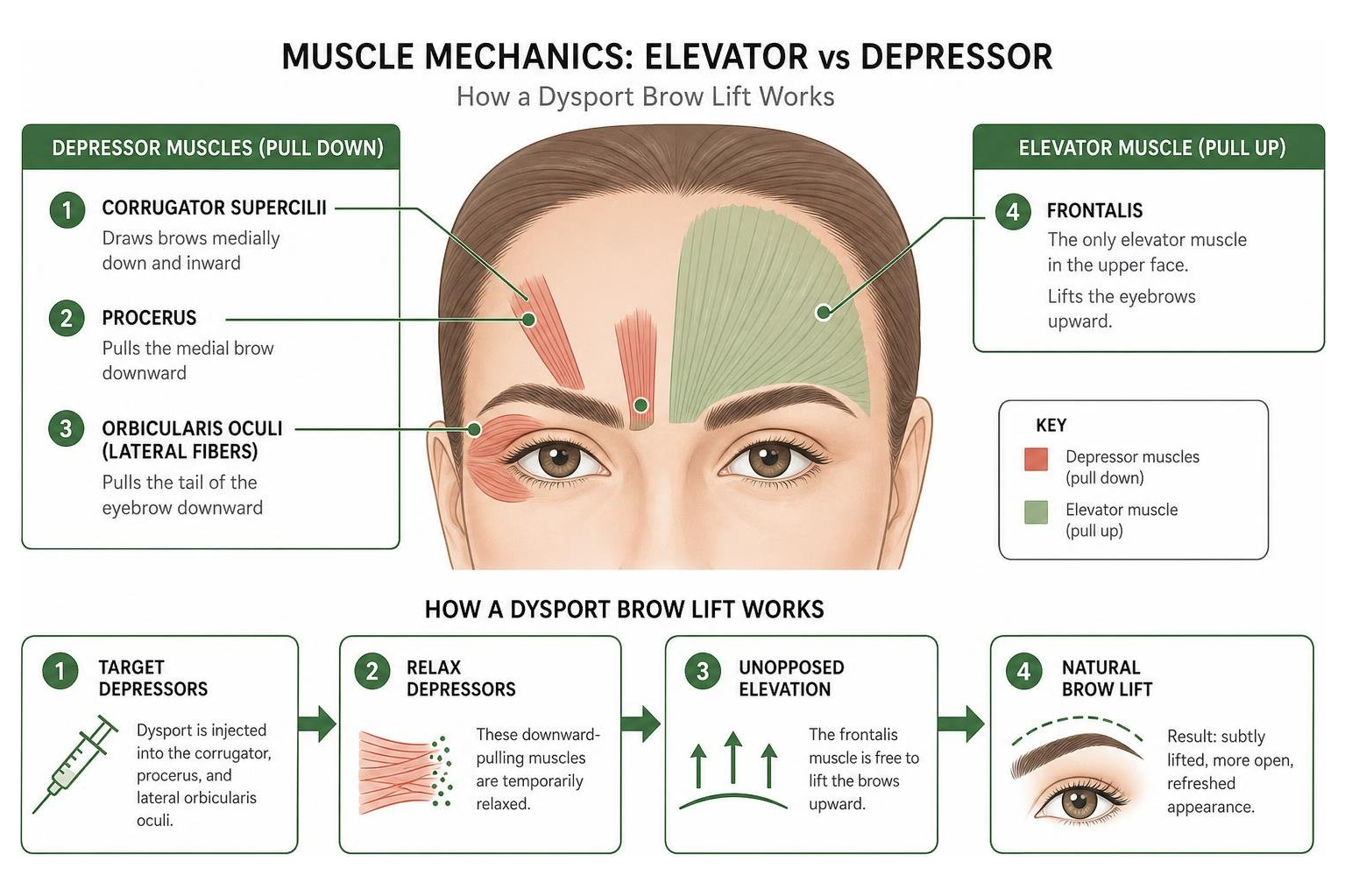
The magic of a chemical brow lift hinges on selective relaxation. If an inexperienced provider injects neuromodulators directly into the lower forehead to smooth lines, they accidentally relax the frontalis muscle—causing the brows to drop even further!
Instead, by carefully injecting Dysport into the glabella complex and the outer orbicularis oculi, we temporarily disarm the downward-pulling forces. This leaves the frontalis muscle free to pull the eyebrows upward unopposed. To learn more about how botulinum toxin type A interrupts signal transmission at the neuromuscular junction, explore the Science of Botox.
Key Injection Points for a Dysport Brow Lift
Achieving a natural, arches-upward shape requires strict adherence to anatomical safe zones and clinical precision. Following established Injection Guidelines for Dysport Brow Lift, our skilled injectors focus on three distinct zones:
- Medial Brow & Glabella (Corrugators & Procerus): Injections into the corrugators (typically 10 mm above the orbital rim) and the procerus soften frown lines while releasing the medial pull on the inner eyebrow.
- Lateral Eyebrow Tail (Orbicularis Oculi): Targeted micro-injections into the upper outer border of the orbicularis oculi relax the depressor fibers responsible for dragging down the outer arch. Injectors use a diagonal mapping approach from the outer iris border upward toward the temple.
- Frontalis Balance Point: While the frontalis is the lifting muscle, high forehead lines may require subtle softening. However, injectors must avoid injecting within 1 cm above the central eyebrow or bony supraorbital ridge to prevent eyelid ptosis or brow droop.
During the treatment, our providers apply gentle finger pressure on the superior medial orbital rim to stabilize the tissue, control needle depth, and prevent the solution from migrating toward the eyelid levator muscles.
Dosing Guidelines and Injection Technique
Because Dysport (abobotulinumtoxinA) uses a different unit measurement system than other neuromodulators, proper dosing is critical. While the standard FDA-approved dose for treating isolated glabellar lines is 50 units (spread over 5 specific points), a customized brow lift usually ranges between 30 and 50 units total, depending on muscle strength and gender.
Here is how a typical dysport brow lift dosage breaks down across muscle groups:
- Corrugator Supercilii: 8–12 units per side (16–24 units total)
- Procerus Muscle: 6–10 units total
- Lateral Orbicularis Oculi: 2–5 units per side (4–10 units total)
Injection Mechanics & Preparation: Our clinical staff reconstitutes a 300-unit vial of Dysport using 1.5 mL or 2.5 mL of sterile, unpreserved 0.9% sodium chloride. The vial is gently rolled between the palms rather than shaken to preserve delicate protein structures, then stored refrigerated at 2–8°C. Using ultra-fine 30-gauge needles, we deliver small, accurate deposits into the belly of each targeted muscle.
Before making any injection, our injectors perform a crucial diagnostic test: we manually depress the patient’s frontalis muscle and ask them to open their eyes widely. If the upper lid droops, it indicates the patient relies heavily on their frontalis to keep their eyes clear. In such cases, conservative dosing is required to prevent unwanted heavy lids.
Dysport vs Botox and Other Injectable Alternatives
When deciding how to rejuvenate your eye area, you might wonder how Dysport compares to other popular neuromodulators on the market. While Dysport, Botox, and Xeomin all utilize botulinum toxin type A to relax underlying muscles, their molecular formulations, spread characteristics, and onset speeds differ.
Here is a side-by-side comparison of the top non-surgical options:
| Feature | Dysport (AbobotulinumtoxinA) | Botox (OnabotulinumtoxinA) | Xeomin (IncobotulinumtoxinA) |
|---|---|---|---|
| Primary Advantage | Faster onset & broader diffusion | Precise, localized control | Pure toxin (no accessory proteins) |
| Onset of Action | 2–3 days | 3–5 days | 3–4 days |
| Peak Effect | 7–10 days | 10–14 days | 10–14 days |
| Duration of Elevation | 3–4 months | 3–4 months | 3–4 months |
| Typical Brow Lift Units | 30–50 units | 10–20 units | 10–20 units |
| Diffusion Spread | Moderate/Wide (Great for large areas) | Low/Concentrated | Moderate |
| Unit Ratio Equivalent | ~2.5 to 3 units per 1 unit Botox | 1 unit | 1 unit |
If you are exploring different neurotoxins, check out our dedicated pages on Botox alternatives and Xeomin options.
Dysport vs Botox for Eyebrow Elevation
The main physical difference between Dysport and Botox lies in their protein structure and diffusion characteristics. Dysport features smaller protective complexing proteins, allowing it to spread or diffuse slightly farther from the exact injection site compared to Botox.
What does this mean for your brow lift?
- Broader, Smoother Coverage: Dysport’s wider diffusion pattern makes it exceptionally effective at fanning across the upper lateral orbicularis oculi and broad forehead areas, creating a soft, feathered elevation without patchy muscle movement.
- Faster Results: Patients who want quick improvements before a weekend event often prefer Dysport because initial changes appear in as little as 2 to 3 days, whereas Botox usually takes 4 to 5 days to begin working.
However, because Dysport diffuses more readily, working with an experienced injector is essential. Precise anatomical placement prevents the product from spreading toward delicate eye tissues. For a deeper look at treating the upper face, read our article on Botox for forehead lines.
Dysport vs Xeomin for Eyebrow Elevation
Xeomin is often dubbed the “naked toxin” because it undergoes additional purification steps to remove accessory proteins, leaving only the active core molecule.
When comparing Dysport and Xeomin for brow elevation:
- Purity vs. Diffusion: Xeomin’s absence of complexing proteins reduces the risk of developing neutralizing antibodies over decades of continuous use. However, Dysport’s subtle diffusion spread often provides a broader, more cohesive lift across the forehead and temple transition zones.
- Onset Speed: Dysport generally takes effect faster (2–3 days) compared to Xeomin (3–4 days). Both products offer similar longevity, maintaining brow elevation for roughly 3 to 4 months.
Expected Results, Duration, and Recovery
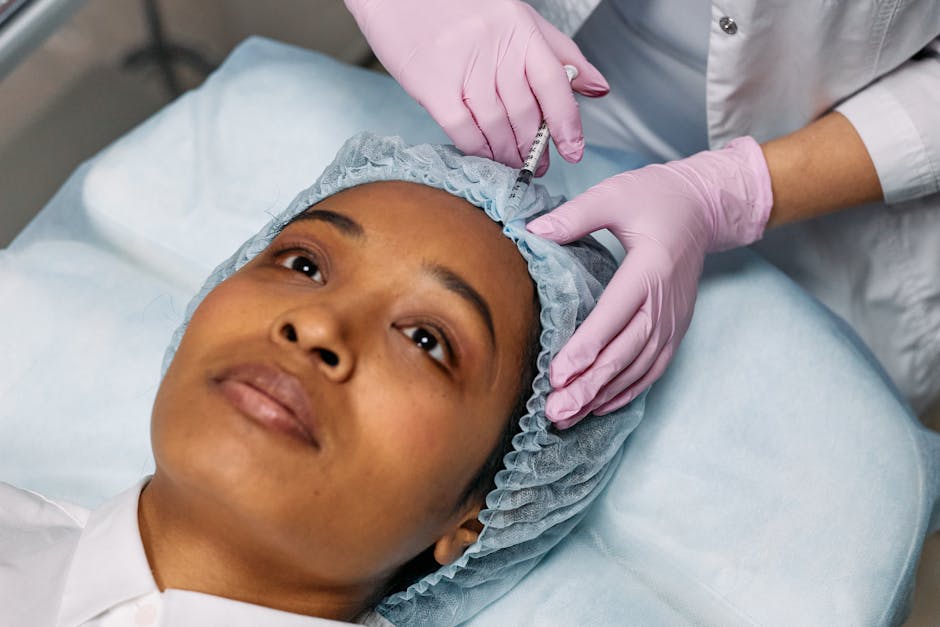
One of the biggest advantages of a dysport brow lift is that there is virtually no downtime. You can receive your injections during a lunch break at our Denver or Aurora locations and return immediately to your normal daily routine.
The Results Timeline
- Days 2–3: You will begin to feel a mild tightening sensation across your brow, and fine lines around your glabella and tail of the eyebrow will start softening.
- Days 7–10: Dysport reaches its peak effect. The depressor muscles are fully relaxed, allowing your frontalis muscle to elevate the outer tail and arch of your eyebrow by approximately 2 to 3 millimeters. Your eyes will appear wider, brighter, and more refreshed.
- Months 3–4: As your body naturally metabolizes the botulinum protein, muscle movement gradually returns. To maintain your elevated look, we recommend scheduling regular touch-ups every 12 to 16 weeks.
Essential Post-Treatment Care
To ensure optimal results and prevent unwanted product migration, follow these recovery guidelines:
- Keep Upright: Do not lie flat or bend over for at least 4 hours after treatment.
- Hands Off: Avoid touching, rubbing, or massaging the treated area for 4 to 6 hours.
- Skip Heavy Workouts: Avoid strenuous exercise, saunas, hot tubs, and heavy sweating for 24 hours.
- Avoid Blood Thinners: Minimize alcohol, aspirin, ibuprofen, fish oil, and garlic supplements for 24 to 48 hours before and after your session to prevent minor bruising.
- Arnica & Cold Compresses: If you are prone to bruising, applying an ice pack gently (without heavy pressure) or taking oral medical-grade arnica can speed up healing.
For additional post-care recommendations, check out our complete guide on Botox recovery tips.
Candidate Selection, Contraindications, and Safety Risks
While a non-surgical brow lift is safe and effective for many people, clear candidate evaluation is key to achieving natural, beautiful results.
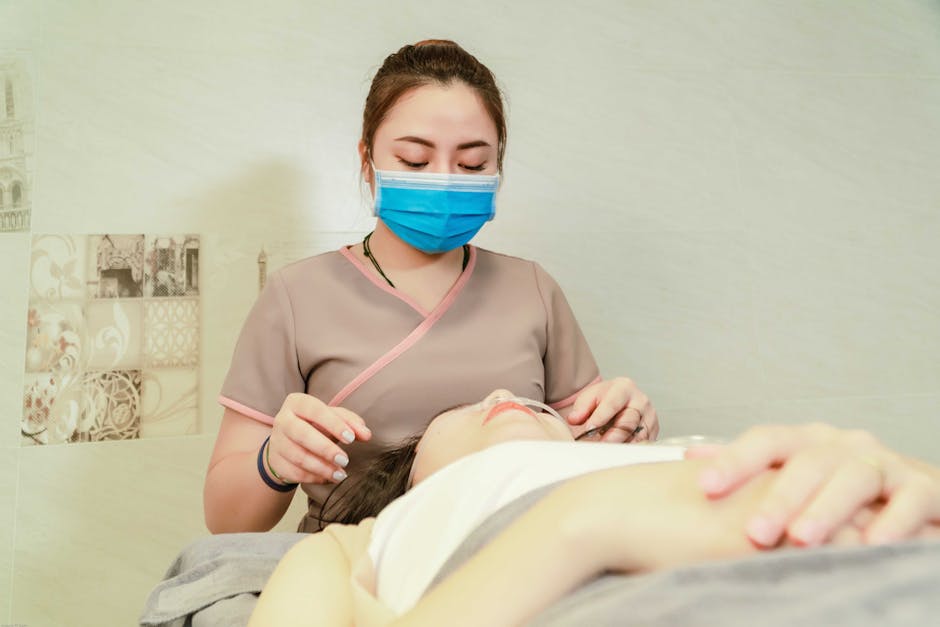
Who Is an Ideal Candidate?
You are likely a great candidate for a dysport brow lift if you:
- Experience mild to moderate brow drooping or heavy upper eyelids.
- Want to soften horizontal forehead lines or “11” frown lines while lifting your brow arch.
- Prefer a non-surgical treatment over invasiveness, scars, and long recovery times.
- Have realistic expectations—understanding that chemical lifts provide a subtle, natural elevation (a few millimeters) rather than dramatic surgical changes.
Primary Contraindications
You should avoid Dysport injections if you:
- Are pregnant, planning to become pregnant, or actively breastfeeding.
- Have a diagnosed neuromuscular disease such as Myasthenia Gravis, ALS (Lou Gehrig’s disease), or Lambert-Eaton syndrome.
- Have a known allergy to botulinum toxin type A or cow’s milk protein (Dysport contains trace milk proteins from its manufacturing process).
- Have an active skin infection, cold sore, or inflammation near the planned injection sites.
Potential Side Effects and Adverse Events
When performed by qualified medical professionals, side effects are typically mild and short-lived:
- Common, Mild Effects: Temporary red bumps at the injection sites (resolving within 30 minutes), minor swelling, light bruising, or a mild headache during the first 24–48 hours.
- Brow Drop or Heavy Lids: If too much product is injected into the lower frontalis muscle, the brow can feel heavy or look flat.
- Eyelid Ptosis: In rare instances (less than 1–2% of cases), if the product diffuses into the levator palpebrae superioris muscle inside the eye socket, the upper eyelid can temporarily droop. This risk is minimized by choosing an experienced injector who follows precise safety boundaries above the orbital rim.
For complete details on our safety standards, browse our Injectables overview.
Non-Surgical vs. Surgical Brow Lifts
If you are considering a brow lift, it helps to understand how non-surgical options compare to formal surgical procedures.
If you have severe skin laxity, significant deep-tissue descent, or upper visual field obstruction caused by heavy hooded eyelids, a surgical procedure such as a Direct Brow Lift may be necessary. Surgical lifts can raise the brow tissue by up to a centimeter or more and last 10 to 15 years, but they require incisions, anesthesia, downtime, and significantly higher upfront costs (often $5,000 to $10,000+).
In contrast, a dysport brow lift:
- Elevates the brow by a few strategic millimeters—perfect for opening up the eye area without altering your natural expression.
- Requires zero surgical incisions or scars.
- Has no downtime—you can return to work immediately.
- Costs a fraction of surgery per session, allowing you to maintain your look on your schedule.
Frequently Asked Questions About Dysport Brow Lifts
How soon do results appear after treatment?
Initial results from a dysport brow lift usually begin appearing within 2 to 3 days after injection. You will notice a subtle relaxing of your frown lines and a lighter feel across your forehead. The full lifting and smoothing effect reaches its peak between days 7 and 10.
What is the recommended dosing of Dysport?
The total recommended dosage for a non-surgical brow lift typically falls between 30 and 50 Dysport units. This total is customized based on your facial muscle mass, eyebrow shape, and aesthetic goals. Generally, 16–24 units are placed in the corrugator muscles, 6–10 units in the procerus, and 4–10 units near the outer tail of the eyebrows.
Who should avoid getting a brow lift with Dysport?
You should avoid Dysport brow lifts if you are pregnant, nursing, allergic to botulinum toxin or cow’s milk proteins, or suffer from underlying neuromuscular disorders like ALS or Myasthenia Gravis. Patients with severe skin laxity or pronounced eyelid droop may be better candidates for surgical consultation.
For more answers to common questions about our aesthetic treatments, explore our Natura Med Spa FAQs.
Conclusion
A dysport brow lift is one of the most effective non-surgical ways to brighten your eye area, lift heavy brows, and smooth stubborn frown lines—all with zero downtime and fast, predictable results. By targeting the downward-pulling depressor muscles around your brows, this treatment lets your forehead naturally lift your eye area for a rested, youthful appearance.
At Natura Med Spa & IV Bar, our expert clinical team delivers customized aesthetic treatments tailored to your unique facial structure across our convenient Colorado locations in Aurora, Denver, and Cherry Creek. We are also proud to offer exclusive military discounts to support our community members.
Ready to refresh your look and give your eyes a subtle, natural lift? Take the next step today:
- Have additional questions? Explore our full Natura Med Spa FAQs.
- Get in touch with our expert medical team via our Contact options.
- Ready for your transformation? Schedule Your Dysport Brow Lift with Natura Med Spa & IV Bar today!