
Perk Up Your Peepers: The Non-Surgical Dysport Eye and Brow Lift
August 5, 2026
The Ultimate Guide to Blood Plasma Injections for Facial Rejuvenation
August 10, 2026
Shaving Away the Years: How Dermaplaning Tackles Dark Spots
Dark Spots Getting You Down? Here’s What a Dermaplane Facial Can Do
If you’ve been searching for a way to tackle dermaplane facial dark spots, here’s the short answer:
Dermaplaning can visibly reduce dark spots by physically removing the top layer of dead, pigmented skin cells — revealing brighter, fresher skin underneath. Results improve with regular sessions every 3–4 weeks.
Quick answers at a glance:
- What it does: Removes dead skin cells and peach fuzz using a sterile scalpel, speeding up cell turnover
- Effect on dark spots: Lifts surface-level pigmentation and helps brightening serums absorb up to 300% better
- Who it works for: Most skin types, including sensitive and darker skin tones
- Downtime: Zero — you can return to normal activities immediately
- How many sessions: Visible improvement typically begins after 2–3 sessions; best results after 6
- Not suitable for: Active acne, eczema, rosacea, or cold sores
You’re busy. You don’t have days to hide at home recovering from a treatment. And yet those stubborn dark spots — from years of sun exposure, old breakouts, or just getting older — aren’t going anywhere on their own.
Age spots, sunspots, and uneven skin tone are among the most common skin concerns people bring to med spas. And most people assume fixing them means lasers, harsh chemical peels, or weeks of peeling skin.
It doesn’t have to be that way.
Dermaplaning is a simple, non-invasive treatment that takes about 30–45 minutes, requires no downtime, and works with your skin’s natural renewal cycle to gradually fade discoloration and restore a more even, radiant complexion.
In this guide, we’ll walk you through exactly how it works, what results to expect, how it compares to other treatments, and everything you need to know before booking your first session at Natura Med Spa & IV Bar.
Shaving Away Pigmentation: The Dermaplane Facial Dark Spots Solution
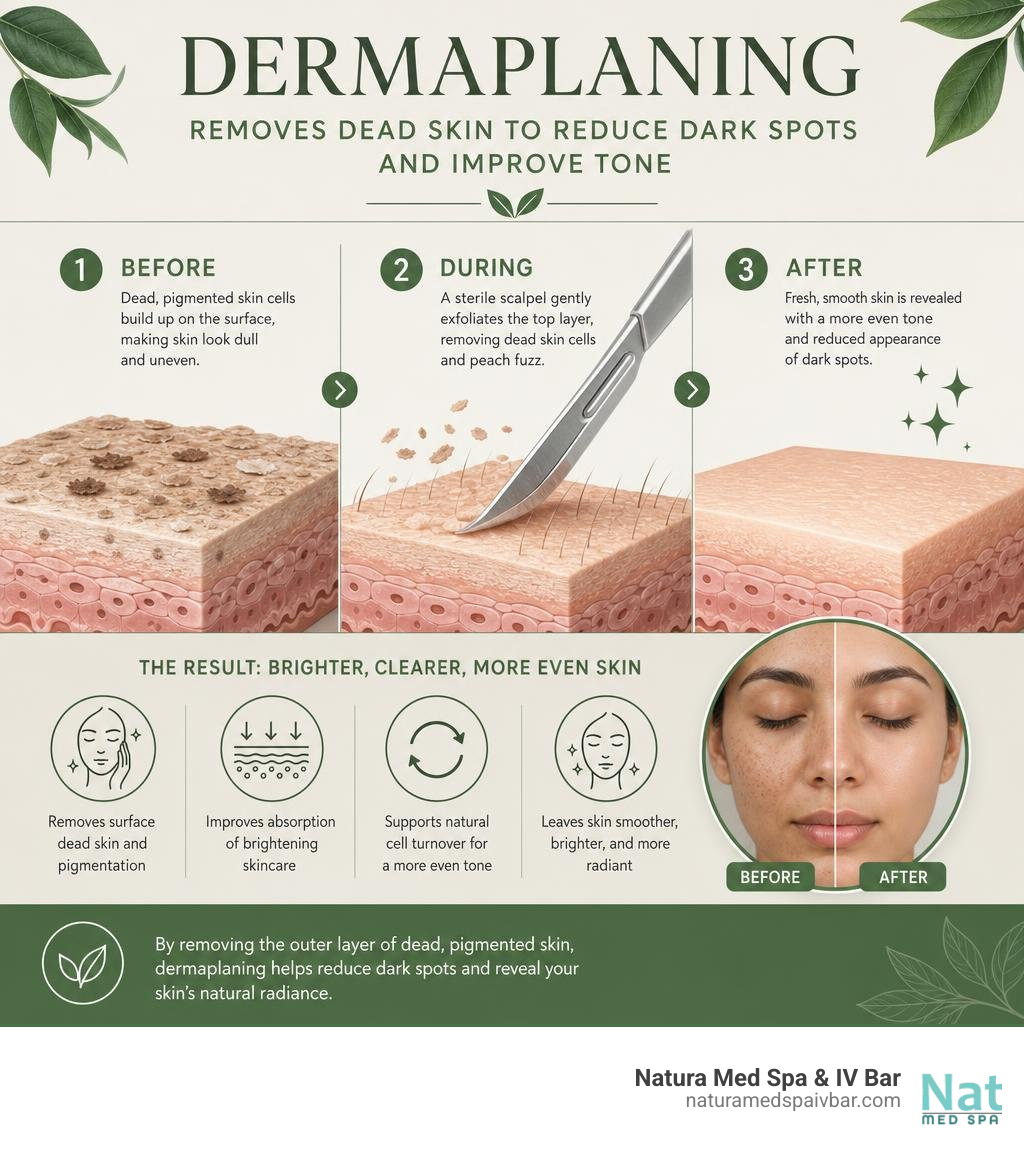
At its core, dermaplaning is a highly controlled physical exfoliation method. During a professional treatment, a trained esthetician uses a medical-grade, sterile scalpel held at a precise 45-degree angle. By gently scraping the surface of your skin, we shave away the accumulated debris of daily life: dead skin cells, trapped oils, environmental pollutants, and that fine vellus hair commonly known as “peach fuzz.”
But how does scraping away peach fuzz and dead skin cells translate to fading stubborn pigmentation?
The secret lies in how your skin behaves when exfoliated. When we remove the top layer of dead skin cells, we trigger a natural wound-healing response in the body, which signals your skin to accelerate its cellular renewal process. This increased cell turnover means your skin produces brand-new, healthy cells at a faster rate, pushing older, pigmented cells to the surface to be sloughed away.
Additionally, physical exfoliation helps break up and disperse localized melanin deposits. Instead of melanin clumped together in visible dark spots or age spots, a smoother skin surface allows for a more even distribution of light, instantly making your skin look brighter and more uniform. To learn more about the head-to-toe advantages of this physical exfoliation, check out this guide on the Benefits of Dermaplaning for Beautiful Skin.
At Natura Med Spa & IV Bar, we customize every treatment to ensure your skin receives exactly what it needs. You can explore our options further by reading More info about dermaplaning services.
How Dermaplaning Fades Hyperpigmentation and Sun Damage
To understand why a dermaplane facial dark spots treatment is so effective, we have to look closely at the structure of our skin. The outermost layer of your skin is the epidermis, and its very top layer is called the stratum corneum. The stratum corneum is composed of flat, dead skin cells (corneocytes) held together by lipids.
When your skin is exposed to UV radiation from the Colorado sun, specialized cells called melanocytes produce melanin—the pigment responsible for your skin’s color. As a defense mechanism, your skin sometimes overproduces melanin in specific areas, leading to sunspots, age spots, and hyperpigmentation. This excess pigment becomes trapped within the cells of the stratum corneum.
By physically scraping away these dead, pigment-laden cells, dermaplaning directly reduces the concentration of surface-level melanin. It quite literally lifts away the damaged cells that make up your dark spots. For a deeper scientific look into how physical exfoliation works, refer to this Dermaplaning and Skin Exfoliation Guide.
Enhancing a Dermaplane Facial Dark Spots Treatment with Brightening Serums
While physical exfoliation alone is fantastic for brightening your skin, the true magic of a dermaplaning facial happens after the blade leaves your skin.
Removing the stratum corneum eliminates the primary barrier to skincare absorption. In fact, clinical studies show that dermaplaning can increase topical product absorption by up to 300%. Without a layer of dead skin and peach fuzz blocking the path, active brightening ingredients can penetrate much deeper into the skin where they can target melanocytes directly.
To maximize your results, we recommend pairing or following your treatment with powerful, scientifically backed brightening agents:
- Vitamin C: A potent antioxidant that inhibits the tyrosinase enzyme, preventing the chemical reaction that creates melanin in the first place.
- Alpha-Arbutin: A natural derivative of hydroquinone that can cut melanin content by up to 60% without the irritation risks associated with stronger synthetic chemicals.
- Niacinamide (Vitamin B3): Rather than stopping melanin production, niacinamide prevents the transfer of pigment into your skin cells. A 4% concentration of niacinamide has been shown in clinical trials to work just as effectively as 4% hydroquinone for melasma, but with far fewer side effects.
- Licorice Root Extract (Liquiritin): An incredibly gentle, botanical brightener. In clinical studies, up to 80% of participants reported excellent improvement in pigmentation when using licorice root extract after physical exfoliation.
For professional insights on matching the right post-treatment serums to your skin goals, read the guide on Dermaplaning Brightening Ingredients: Best Post-Treatment – DermaplaningSupplies.com.
Dermaplaning vs. Other Dark Spot Treatments
If you are trying to decide which treatment is right for your skin, it helps to see how they stack up side-by-side. Below is a quick comparison of our most popular skin-brightening treatments:
| Feature | Dermaplaning | HydraFacial | Microneedling |
|---|---|---|---|
| Primary Method | Physical blade exfoliation | Vortex-fusion exfoliation & serum infusion | Collagen induction via micro-needles |
| Downtime | Zero | Zero | 24–48 hours of mild redness |
| Pain Level | None (feels like a light scratch) | None (feels like a cool paintbrush) | Mild (numbing cream is applied) |
| Best For | Surface dark spots, peach fuzz, instant glow | Dehydration, mild pigmentation, clogged pores | Deep dark spots, acne scars, fine lines |
| Chemical-Free? | Yes | No (uses mild glycolic/salicylic acids) | Yes |
Dermaplaning is a highly attractive option because it is completely non-invasive, requires absolutely no downtime, and is entirely chemical-free. This makes it an ideal choice for pregnant or nursing mothers who want to treat the “mask of pregnancy” (melasma) but must avoid chemical exfoliants.
If you want to read more about how our other advanced therapies compare, check out More info about Hydrafacial services or read More info about Microneedling services.
Dermaplaning vs. Fire & Ice Facials
Our Fire & Ice Facial is another incredible treatment for skin rejuvenation, but it works very differently from dermaplaning.
The Fire & Ice treatment is a clinical-grade peel that utilizes active ingredients like glycolic acid, lactic acid, and retinol to rapidly exfoliate the skin. Because it relies on chemical reactions rather than physical scraping, it can sometimes trigger temporary skin sensitivity or mild flaking, especially if you have highly reactive skin.
Dermaplaning, on the other hand, involves zero acids or peeling agents during the exfoliation step. This makes it a much safer, more predictable option for clients with extremely sensitive skin who still want to address dark spots without risking a chemical reaction. If you want to compare these two powerhouse facials, read More info about Fire & Ice facials.
Dermaplaning vs. Microneedling and Nouvaderm
For deeper, more stubborn hyperpigmentation, such as deep sun damage or dark spots left behind by severe acne, physical surface exfoliation might need some reinforcement. This is where treatments like microneedling and Nouvaderm come into play.
While dermaplaning focuses strictly on the very surface of the epidermis, microneedling reaches the deeper dermal layers. By creating microscopic channels in the skin, microneedling triggers a massive surge in collagen production and cellular renewal.
Nouvaderm treatments also target deeper structural concerns to promote rapid skin remodeling. While these treatments are incredibly effective for long-term skin health, they do require a brief recovery period. Many of our clients choose to alternate between dermaplaning and deeper treatments to get the best of both worlds: instant surface-level brightness and deep structural rejuvenation. Discover how these deeper treatments work by reading More info about Nouvaderm treatments.
Safety, Side Effects, and Skin Tone Considerations

One of the greatest misconceptions in the skincare world is that aggressive treatments are always better. When it comes to hyperpigmentation, aggressive treatments can actually backfire, particularly for those with sensitive skin or richer skin tones.
Understanding your skin’s unique physiology is the key to achieving a glowing, spot-free complexion safely. For an overview of general safety guidelines, see these Dermaplaning Facts and Safety.
Is Dermaplaning Safe for Darker Skin Tones?
Yes! Dermaplaning is considered exceptionally safe for all Fitzpatrick skin types, including dark, melanin-rich skin tones.
The reason dermaplaning is so highly recommended for darker skin is that it is a physical, non-thermal (heat-free) treatment. Many laser treatments and deep chemical peels carry a risk of triggering post-inflammatory hyperpigmentation (PIH) in darker skin tones. PIH occurs when the skin experiences heat, trauma, or chemical irritation, causing melanocytes to go into overdrive and create more dark spots.
Because professional dermaplaning does not use heat or harsh chemicals, the risk of triggering PIH is extremely low. However, because a surgical blade is involved, it must be performed by an experienced professional. A skilled esthetician knows how to glide the blade smoothly across the skin without causing nicks or irritation that could trigger a pigment response. To learn more about how physical exfoliation preserves the integrity of melanin-rich skin, read this guide on Dermaplaning for Dark Skin Tones.
Who Should Avoid Dermaplaning?
While dermaplaning is incredibly gentle, it is not suitable for everyone. You should avoid or postpone a dermaplaning treatment if you currently have:
- Active, Inflamed Acne: Gliding a surgical scalpel over active breakouts can nick the blemishes, spread acne-causing bacteria across your face, and worsen inflammation.
- Eczema, Psoriasis, or Rosacea Flare-ups: If your skin barrier is compromised, red, or actively inflamed, physical exfoliation will only cause further irritation.
- Active Cold Sores: The scraping motion of the blade can spread the herpes simplex virus to other areas of your face.
- Recent Isotretinoin Use: If you have taken prescription acne medications like isotretinoin within the last six months, your skin is too thin and fragile for physical exfoliation.
If you have active acne or highly reactive skin, we recommend treating the underlying inflammation first with specialized services like a soothing clinical facial or a targeted Nouvaderm treatment before scheduling a dermaplaning session. For more details on these specialized treatments, see More info about Nouvaderm treatments.
What to Expect: Treatment Frequency and Aftercare
If you are planning to book a dermaplane facial dark spots session, knowing how to prepare and care for your skin will ensure you get the absolute best results. For a complete timeline of what to expect before, during, and after your session, read What to Expect From Dermaplaning.
Expected Results: Is a Dermaplane Facial Dark Spots Solution Permanent?
It is important to have realistic expectations: dermaplaning does not permanently remove dark spots.
Dermaplaning clears away the pigmented dead skin cells currently sitting on the surface of your face. However, it does not stop your melanocytes from producing new melanin deep within your skin. If you go out into the hot Colorado sun without sun protection, those dark spots will eventually return.
Because your skin naturally goes through a full regeneration cycle roughly every 30 days, a new layer of dead skin cells (and potentially new pigment) will slowly accumulate. To maintain your bright, even complexion, dermaplaning should be viewed as an ongoing maintenance treatment. Regular sessions, combined with a daily brightening skincare routine and diligent sun protection, are the keys to keeping dark spots at bay long-term. To learn more about the longevity of physical exfoliation results, read this article on Dermaplaning Results and Longevity.
Post-Treatment Aftercare and Recovery
After a dermaplaning facial, your freshly exposed skin will be highly receptive to skincare products, but it will also be more vulnerable to environmental damage. To protect your investment and prevent new dark spots from forming, follow these simple aftercare steps:
- Wear SPF 30+ Daily: This is non-negotiable. Your skin will be more sensitive to UV rays for about a week following treatment. Apply a broad-spectrum, mineral sunscreen every single morning, and reapply every two hours if you are spending time outdoors in Denver or Cherry Creek.
- Keep It Gentle: Use a mild, hydrating cleanser twice daily. Avoid harsh scrubs, loofahs, or facial brushes for at least one week.
- Hydrate, Hydrate, Hydrate: Apply hydrating serums rich in hyaluronic acid or soothing botanicals. If you want to pamper your skin with a deeply nourishing enzyme treatment post-session, check out More info about Honey Enzyme facials.
- Pause Strong Actives: Wait at least 72 hours before reintroducing strong active ingredients like retinol, glycolic acid, salicylic acid, or hydroquinone back into your routine to prevent irritation.
Frequently Asked Questions about Dermaplaning for Dark Spots
How many dermaplaning sessions are needed to see a difference in dark spots?
While you will notice an instant boost in skin smoothness and radiance after just one 30-minute session, fading dark spots requires consistency. Because hyperpigmentation lives in multiple layers of the skin, you will typically start to see a visible reduction in dark spots after 2 to 3 sessions. For the most dramatic, cumulative results, we recommend a series of 6 treatments spaced 3 to 4 weeks apart, which aligns perfectly with your skin’s natural 30-day cell turnover cycle.
Can dermaplaning make my dark spots or melasma worse?
When performed correctly by a licensed professional, dermaplaning will not make your dark spots or melasma worse. However, if you attempt to dermaplane at home with cheap, non-sterile razors, or if you go to an untrained provider, you run the risk of scratching or irritating the skin. This inflammation can trigger post-inflammatory hyperpigmentation, making dark spots darker. Additionally, because sun exposure is the primary trigger for melasma, failing to wear sunscreen after your treatment can cause the pigmentation to return quickly.
Can I combine dermaplaning with other med spa treatments?
Absolutely! In fact, we highly recommend combining dermaplaning with other treatments to supercharge your results. Because dermaplaning removes the dead skin barrier, combining it with a mild chemical peel, a Hydrafacial, or a soothing enzyme facial allows those active treatments to penetrate much deeper and work far more effectively. To see our full menu of customizable treatment pairings, explore More info about our Med Spa Services.
Conclusion
If you are tired of stubborn dark spots making you look older or more tired than you feel, a professional dermaplaning facial is a fantastic, zero-downtime solution. By clearing away dead skin cells and peach fuzz, this gentle treatment kickstarts your skin’s natural renewal process and allows your favorite brightening serums to work up to 300% better.
At Natura Med Spa & IV Bar, we specialize in convenient, results-driven beauty and wellness treatments tailored to your busy lifestyle. Whether you live in Aurora, Denver, or Cherry Creek, our expert team is here to help you achieve your ultimate skin goals. Plus, we are proud to support our community by offering military discounts on our services.
Ready to reveal a brighter, smoother, and more youthful complexion? Schedule a Dermaplane Facial today and let us help you shave away the years!