
Ultimate Checklist for Finding Botox Providers in Denver
September 14, 2026
Finding Reliable Semaglutide Follow Up Care in Your Neighborhood
September 18, 2026
Everything to Consider Before Injecting Under-Eye Botox
Is Botox Under Eyes Right for Your Concern?
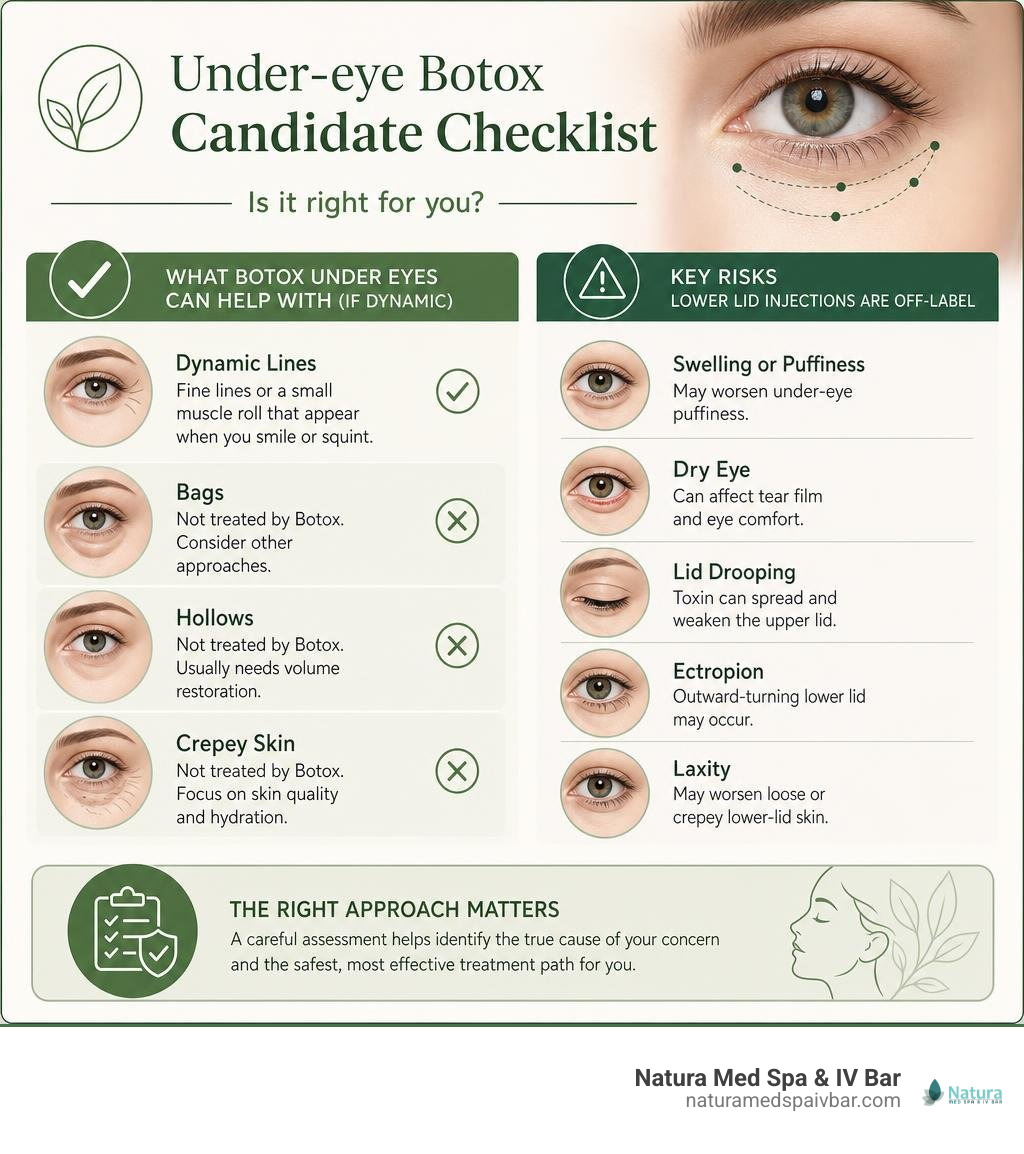
Botox under eyes can soften a small muscle roll or fine lines that appear only when you smile or squint. It does not remove under-eye bags, tear-trough hollows, dark circles, or crepey lines that remain visible at rest. Because lower-lid injections are off-label and can worsen puffiness or lid laxity, start with a careful assessment rather than booking treatment based on a selfie.
Before agreeing to injections, ask your injector to:
- Identify whether your concern is dynamic wrinkling, bags, hollowing, pigment, or skin texture.
- Check lower-lid tone with a snap-back test.
- Explain the small planned dose – often about 2 to 4 units per side – and why it is being used.
- Discuss safer alternatives if puffiness, dry eye, laxity, or structural volume loss is the main issue.
The lower eyelid has very thin skin and a muscle that supports blinking and fluid movement. Relaxing that muscle can be helpful for the right person, but too much toxin may lead to swelling, dry eye, lid drooping, or an outward-turning lower lid called ectropion. That is why many experienced injectors treat this area cautiously, or decide not to treat it at all.
I am Abla Jad, a CFO, advisor, and founder with more than a decade of experience turning complex decisions into practical, clear action. My operator-focused perspective on Botox under eyes emphasizes informed screening, realistic expectations, and choosing the treatment that matches the actual cause of an under-eye concern.
Understanding Lower Eyelid Anatomy and What Neurotoxins Can Treat
To understand how neurotoxins behave beneath the eye, you have to look at the delicate mechanics at play. The skin below your eyes is roughly 0.5 millimeters thick—making it among the thinnest, most fragile skin on your entire body. Sitting directly beneath this paper-thin dermis is the orbicularis oculi, a circular muscle that rings your eye socket. This muscle closes your eyelids, assists in blinking, supports the lower lid against gravity, and acts as a dynamic lymphatic pump that pushes interstitial fluid out of the lower eyelid tissues.
When evaluating wrinkles around this delicate framework, clinical experts distinguish between dynamic and static lines. Dynamic wrinkles occur solely when muscles contract (such as when you smile, laugh, or squint). Static lines, by contrast, are etched into the skin and remain visible even when your face is completely relaxed.
Understanding the science of Botox is key here: botulinum toxin type A works by temporarily blocking acetylcholine signals at the neuromuscular junction, preventing target muscle fibers from contracting. As outlined in clinical overviews like Botox under eyes: Effectiveness, side effects, and alternatives, neurotoxins are designed exclusively to relax muscular movement. They do not rebuild lost collagen, fill hollows, or dissolve orbital fat pads.
What Botox Under Eyes Actually Treats: Dynamic Smile Lines and the Jelly Roll
There is essentially one primary aesthetic indication for lower eyelid neurotoxin: dynamic bunching caused by the pretarsal orbicularis oculi.
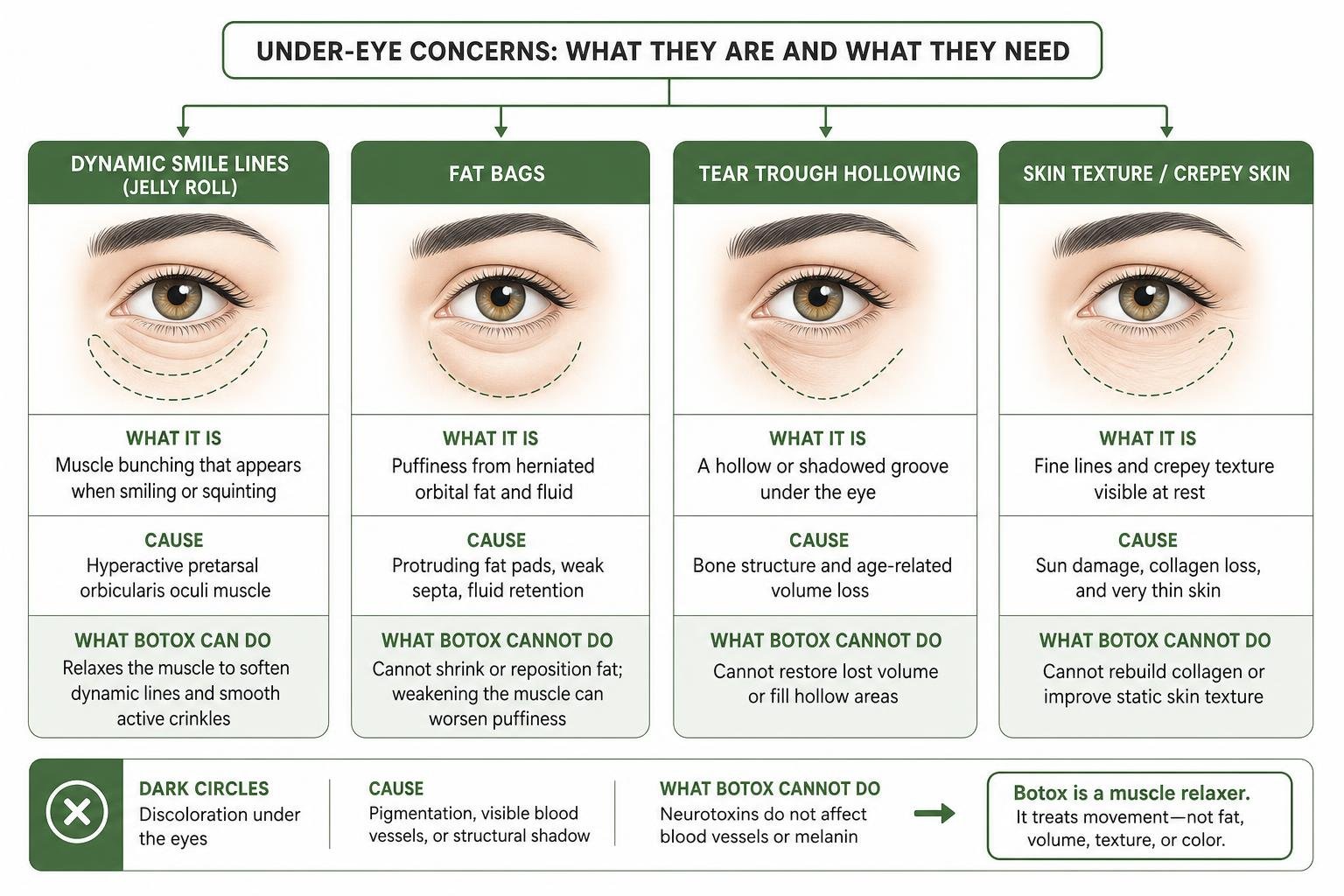
When some people smile or squint, this hyperactive strip of muscle immediately beneath the lower lash line bunches upward into a distinct, shelf-like ridge. On social media, this dynamic feature has been popularized as the “jelly roll.” In carefully selected candidates, placing micro-droplets of toxin into the pretarsal muscle softens this active bunching, smooths dynamic accordion smile crinkles, and can subtly widen the vertical eye aperture for a more rested, open-eyed look.
What Botox Cannot Fix: Bags, Hollowing, Crepiness, and Dark Circles
Because “tired eyes” is an umbrella term, patients frequently seek neuromodulators for problems that muscle relaxers simply cannot resolve—and can actively worsen:
- Infraorbital Fat Bags: True under-eye bags are caused by herniated orbital fat pushing against weakened orbital septa, combined with fluid retention. Relaxing the orbicularis oculi cannot shrink or reposition fat; in fact, weakening the muscle impairs lymphatic clearance and often makes puffiness more prominent.
- Tear Trough Hollowing: Deep shadows and hollow valleys beneath the eyes stem from facial bone structure, genetics, and age-related volume loss in deep fat compartments. Toxins cannot restore lost volume.
- Static Crepey Texture: Fine, paper-like crinkles present when your face is at rest stem from sun damage, collagen depletion, and thin skin, not active muscle contraction.
- Dark Circles: Periorbital discoloration is caused by hyperpigmentation, genetic skin translucency showing underlying vascular networks, or structural shadowing from adjacent hollows. Neurotoxins have no effect on blood vessels or melanin.
How Botox Under Eyes Works: Indications, Dosing, and Technique
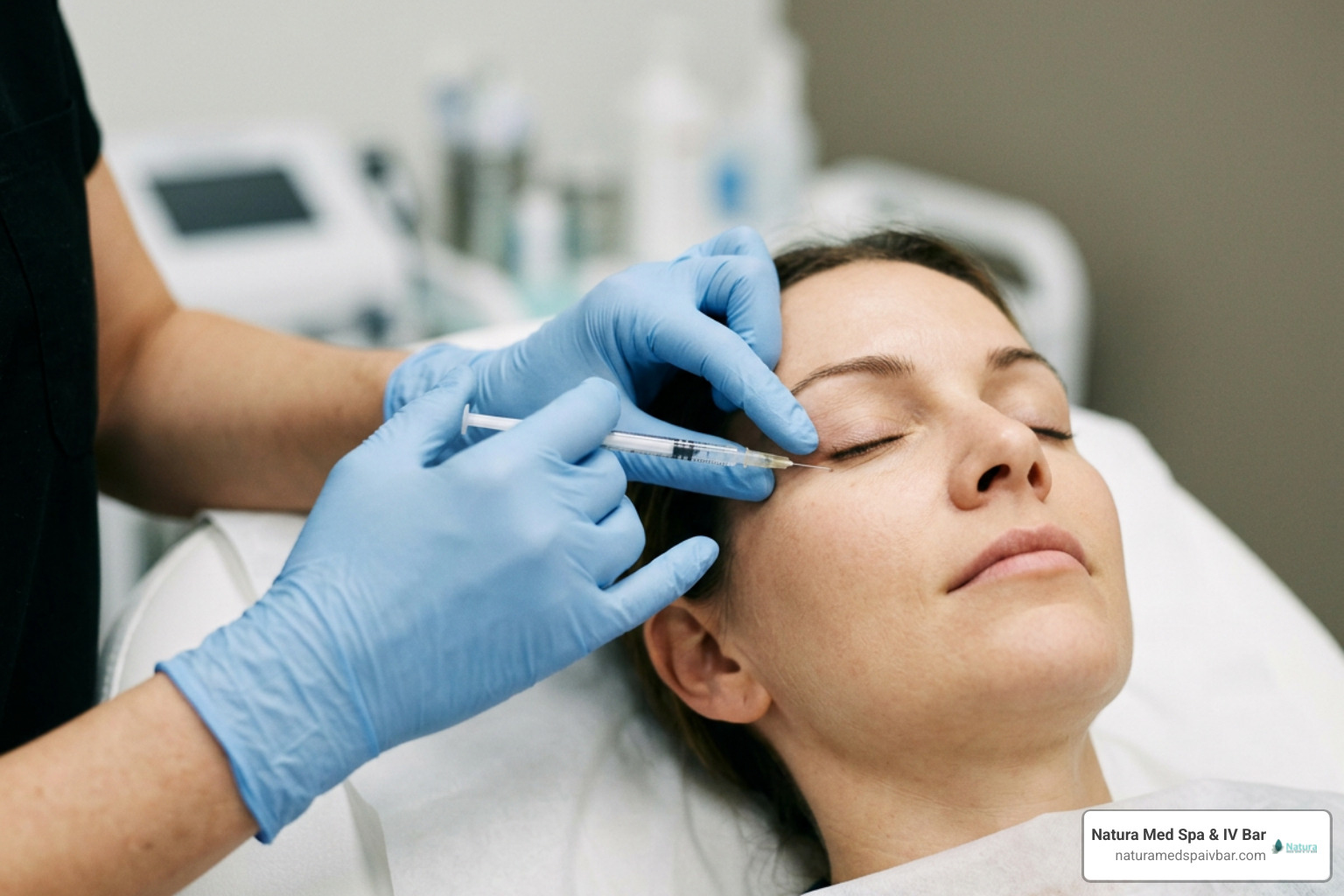
Administering neurotoxins to the lower eyelid requires exceptional precision. Because the therapeutic window between wrinkle smoothing and functional muscle impairment is razor-thin, injectors utilize a conservative microdosing approach using standard injectables/botox preparations.
The injector deposits tiny, superficial intradermal wheals—typically 1 to 2 units per injection point across 1 or 2 sites per eye, totaling only 2 to 4 units per side (4 to 8 units total). Placing the product superficially just beneath the skin helps prevent the toxin from diffusing into deeper muscular layers responsible for supporting the lower eyelid against the globe.
Under-Eye vs. Standard Facial Botox Treatments
| Treatment Area | Typical Dose | Target Muscle | FDA Approval Status | Onset & Longevity |
|---|---|---|---|---|
| Under Eyes | 2–4 units per side (4–8 units total) | Pretarsal orbicularis oculi | Off-label | Onset: 3–7 days; Duration: 8–10 weeks |
| Crow’s Feet | 6–12 units per side (12–24 units total) | Lateral orbital orbicularis oculi | FDA approved | Onset: 3–7 days; Duration: 3–4 months |
| Forehead Lines | 10–30 units total | Frontalis muscle | FDA approved | Onset: 3–7 days; Duration: 3–4 months |
How Botox Under Eyes Compares to Crow’s Feet Treatments
Treating lateral canthal lines (crow’s feet) is fundamentally different from treating the lower eyelid. Crow’s feet injections target the outer edge of the orbicularis oculi, using 6 to 12 units per side. This is an FDA-approved application supported by extensive clinical trials. Crow’s feet injections carry a high safety profile because they do not compromise the lower eyelid’s structural support or interfere with the blink reflex.
In contrast, lower-lid injections remain strictly off-label. In fact, a 2003 clinical study revealed that patients who received Botox in both the crow’s feet and the lower eyelid achieved significantly better satisfaction than those receiving lower-lid injections alone. In the lower lid, high doses (such as 8 units) yielded strong smoothing but dramatically increased side effects. When aesthetic practitioners treat the eye area, addressing the crow’s feet is the primary, well-studied strategy, while lower-lid micro-touches are reserved as an occasional, conservative refinement.
Step-by-Step Diagnostic Assessment: The Snap-Back Test
Before placing any needle near your lower eyelid, an injector must perform a physical diagnostic evaluation to ensure your lower lid has enough structural elasticity to handle muscle relaxation.
The gold standard evaluation is the snap-back test:
- Lower Lid Distraction: The injector gently grasps your lower eyelid skin and pulls it downward and outward away from the eyeball.
- Release Assessment: The injector releases the eyelid and watches how it returns to resting position without allowing you to blink.
- Grading Tone: If the lid instantly snaps back against the globe, your lid tone and canthal tendon support are strong. If the lid returns slowly, remains tented away from the eye, or requires a blink to return to position, significant lid laxity is present.
If your snap-back test shows laxity, under-eye neurotoxin is contraindicated. Relaxing a lax muscle risks pulling the lid completely away from the eye, causing functional and aesthetic complications.
Safety Risks, Complications, and Contraindications
Because botulinum toxin type A temporarily paralyzes muscle tissue, relaxing the lower eyelid orbicularis oculi carries unique anatomical risks:
- Ectropion and Lower Lid Retraction: If the lower orbicularis loses too much tone, gravity pulls the lower eyelid downward and outward (ectropion), exposing the conjunctiva and sclera. This creates a rounded, “startled” eye shape and prevents proper closure.
- Impaired Blinking and Dry Eye: The lower lid helps spread the tear film across the cornea. Weakening this muscle can cause incomplete eyelid closure (lagophthalmos), severe dryness, irritation, and potential corneal exposure.
- Fluid Stasis and Worsened Puffiness: Blinking acts as a natural lymphatic pump. When the muscle is relaxed, fluid clearance stalls, leading to localized edema and noticeably worse under-eye bags, especially in the morning.
- A “Dull” or Unnatural Smile: Over-relaxing the lower eyelid prevents the normal upward cheek-and-lid movement that characterizes an authentic smile, leaving expressions looking flat or frozen.
Adhering to standard Botox Recovery Tips—such as remaining upright for four hours and avoiding rubbing the eyes—is critical to prevent unintended product migration.
Who Should Avoid Under-Eye Neurotoxin Injections
Reputable practitioners decline under-eye neurotoxin treatments for candidates presenting with:
- Poor lower eyelid snap-back or visible eyelid laxity
- Baseline under-eye bags, festoons, or morning fluid puffiness
- Prior lower blepharoplasty (which alters muscle tone and eyelid mechanics)
- A “positive vector” orbital anatomy (where the eyeball protrudes forward relative to the cheekbone, increasing lower lid exposure risk)
- Pre-existing dry eye syndrome or chronic eye irritation
- Neuromuscular conditions such as myasthenia gravis, ALS, or Lambert-Eaton syndrome
Essential Questions to Ask an Injector Before Treatment
To protect your safety and achieve natural results, ask your injector these questions during your consultation:
- “Do you consider under-eye Botox an off-label treatment, and what is your protocol for assessing my eyelid support?”
- “Will you perform a physical snap-back test before deciding whether to inject?”
- “How many total units do you plan to use under each eye?” (You should expect a conservative answer of 1 to 4 units per side).
- “Based on my anatomy, is my concern dynamic muscle movement, structural volume loss, or fluid retention?”
- “What is your protocol if I experience lower lid drooping or worsening fluid retention?”
More Effective Alternatives for Lower Eyelid Concerns
When Botox is not suitable for your specific lower eyelid anatomy, several advanced non-surgical modalities can rejuvenate the periorbital area without compromising muscle tone.
If skin laxity, crepey texture, or fine static etching is your primary concern, energy-based skin remodeling often delivers superior results. Exploring non surgical skin tightening modalities allows you to rebuild the structural integrity of thin lower eyelid skin.
For instance, learning everything you need to know about a full face fibroblast treatment demonstrates how plasma energy stimulates immediate tissue contraction and long-term collagen synthesis, firming crepey skin without affecting muscle mechanics or lymphatic flow.
Targeted Solutions for Bags, Hollows, and Fine Texture
- For Tear Trough Hollows: Deeply placed hyaluronic acid dermal fillers or platelet-rich plasma (PRP/PRF) can restore structural volume beneath the muscle layer, softening dark shadow valleys without weakening eyelid dynamics.
- For Crepey Skin & Fine Texture: Professional chemical peels, fractional non-ablative lasers, and medical-grade topical retinoids thicken the dermis and boost elastin over time.
- For Morning Fluid Puffiness: Targeted lymphatic facials, sleeping with the head elevated, reducing dietary sodium, and using topical caffeine-infused eye serums help constrict superficial vessels and drain stagnant interstitial fluid.
Frequently Asked Questions About Under-Eye Botox
How long does Botox last when injected under the eyes?
While Botox placed in high-dose facial areas (like the forehead or glabella) typically lasts 3 to 4 months, under-eye micro-dosing generally lasts around 8 to 10 weeks (roughly 2 to 2.5 months). Because injectors use tiny micro-doses (1 to 2 units per site) to protect eyelid function, the body metabolizes the neurotoxin more quickly, causing muscle movement to return sooner.
How much does under-eye Botox typically cost?
Botox is commonly priced between $9 and $16 per unit. At 2 to 4 units per side (4 to 8 units total), the raw unit cost ranges from roughly $36 to $128. However, because many aesthetic practices maintain minimum appointment fees (often around $125), treating the under-eyes as an isolated procedure may reflect the clinic’s minimum baseline charge. Most patients choose to combine under-eye micro-touches with crow’s feet or upper facial treatments.
What should I do if I experience eyelid drooping or complications after under-eye Botox?
Unlike hyaluronic acid dermal fillers, there is no pharmacological enzyme to dissolve or reverse Botox. The neurotoxin binds to nerve receptors and must wear off naturally through cellular turnover over several weeks.
If you experience complications such as lid laxity, lagophthalmos, or dry eye:
- Contact Your Provider Immediately: Schedule a clinical follow-up so your injector can assess corneal coverage and lid position.
- Protect the Ocular Surface: Use preservative-free lubricating artificial tears during the day and a thicker ophthalmic lubricating ointment at night to prevent corneal abrasion.
- Manage Temporary Edema: If lymphatic pooling causes puffiness, use gentle cool compresses, elevate your head during sleep, and avoid high-sodium meals while the neurotoxin gradually metabolizes.
Conclusion
Botox under the eyes is not a universal fix for looking tired. While a conservative micro-dose can beautifully soften a dynamic smile roll or fine animated crinkles in a candidate with excellent lid elasticity, it does nothing for herniated fat bags, hollow tear troughs, dark pigmentation, or static crepey skin.
Achieving a refreshed, naturally youthful eye area requires matching the right aesthetic modality to your unique anatomy. If you are exploring periorbital rejuvenation, trust an experienced provider who understands delicate facial mechanics, uses conservative dosing principles, and prioritizes your long-term ocular safety.
To explore personalized aesthetic treatments, tailored facials, and advanced skin rejuvenation designed for your goals, schedule a personalized aesthetic consultation with our expert team at Natura Med Spa & IV Bar today.