Why the Natural Lip Flip Is Quietly Replacing Heavy Fillers
August 28, 2026
A Practical Guide to Lip Filler Basics for Beginners
September 7, 2026
Detailed Guide to Masseter Botox Safety and Results
What Masseter Botox Can and Cannot Do
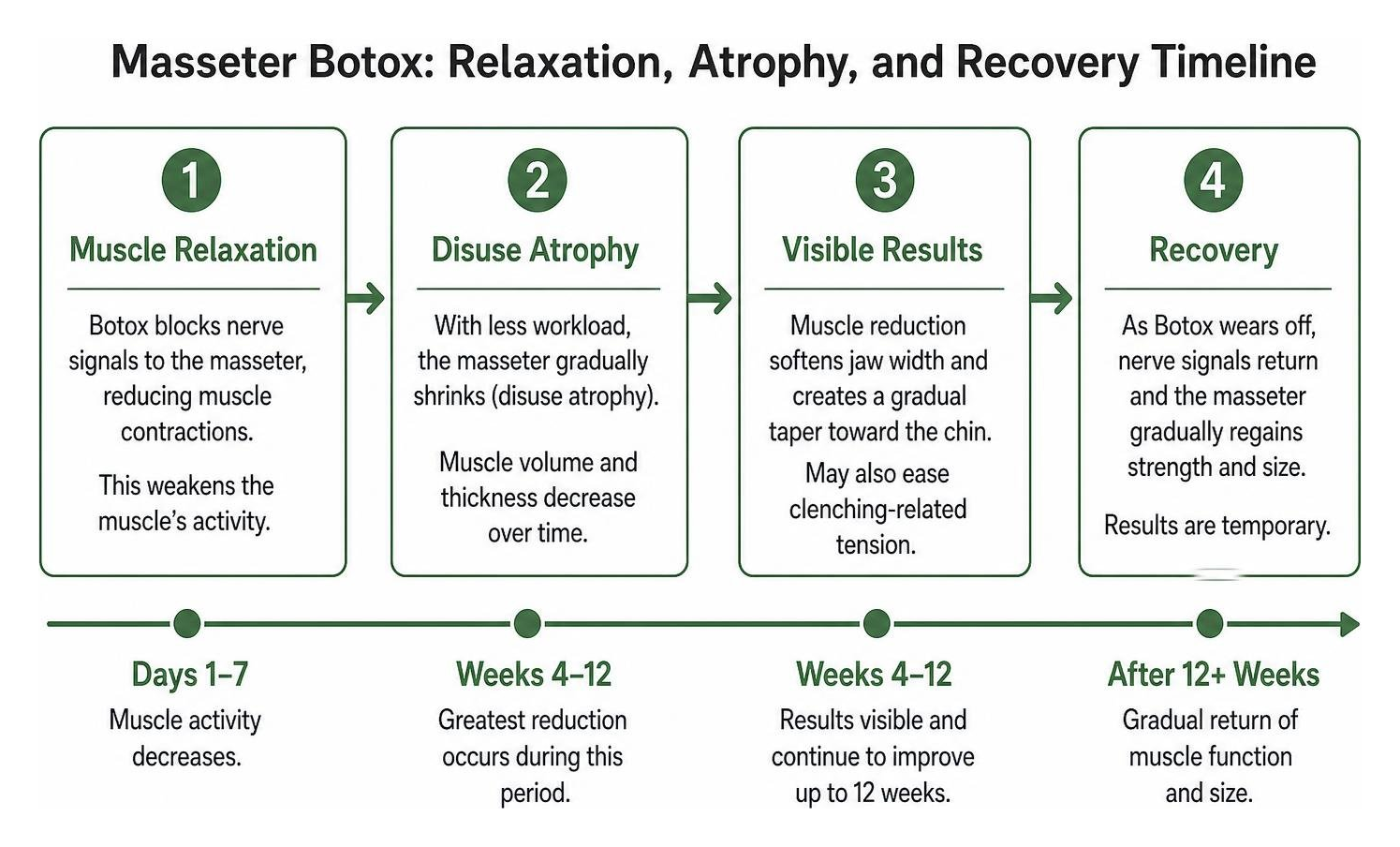
Masseter Botox can slim a wide lower face caused by enlarged chewing muscles. It works by temporarily weakening the masseter muscle, so it gradually shrinks over the next 4 to 12 weeks. Results can soften a square jawline and may ease clenching-related tension, but treatment can also reduce bite strength and chewing endurance for a time.
This is not a universal face-slimming treatment. It works best when jaw width comes from muscle bulk, not a prominent jawbone, facial fat, or loose skin. A careful clench assessment and conservative dose matter because over-treatment may contribute to smile asymmetry, hollow-looking cheeks, or more visible jowls in some people.
Masseter Botox is also off-label for cosmetic jaw slimming in the United States. That does not mean it is inherently unsafe, but it does mean the provider’s anatomy knowledge, product selection, injection placement, and patient screening are especially important. This guide explains the likely results, real functional tradeoffs, and ways to reduce avoidable risk.
I am Abla Jad, a finance and strategy advisor who has built and scaled a multi-location med spa business. My operator-focused perspective on masseter Botox emphasizes clear decisions, realistic expectations, and safety-conscious treatment planning.

Aesthetic and Functional Benefits of Masseter Botox
The masseter is one of the strongest muscles in the human body relative to its size. When it becomes enlarged—a condition known as masseter hypertrophy—it broadens the lower third of the face, transforming an oval or heart-shaped contour into a heavier, square profile. While this muscular enlargement is benign, it often presents alongside chronic clenching, bruxism (nighttime teeth grinding), and tension headaches.
When botulinum toxin is injected into the masseter, it blocks the presynaptic release of acetylcholine at the neuromuscular junction. Without this chemical signal, muscle contractions decrease. Over time, the reduced workload leads to targeted disuse atrophy, shrinking muscle volume while easing chronic jaw tension. Rigorous clinical research on masseter prominence and muscle reduction demonstrates that this volume reduction creates measurable changes in facial width, muscle thickness, and neuromuscular output.
How Masseter Botox Creates Lower Facial Slimming
Masseter reduction creates a gradual taper toward the chin. Rather than changing bone structure, it reduces the soft-tissue muscular bulge that sits over the angle of the jaw. If you want to transform your face shape with non-surgical Botox cheek slimming, understanding the volumetric shift is essential.
Recent clinical data utilizing 3D facial imaging shows that bilateral masseter neurotoxin treatments lead to a combined lower-face volume reduction exceeding 10,000 mm³ at 4 weeks, expanding to over 13,000 mm³ by week 12. In individual measurements, this translates to roughly 2,500 to 3,100 mm³ of reduction per side at month one, and up to 3,600 to 6,800 mm³ per side by month two.
In clinical case tracking, targeted dosing can reduce the distance from the mandibular angle to the pogonion (the anterior-most point of the chin) from 15.8 cm down to 13.3 cm on a treated side. This structural refinement narrows the lower facial framework without surgery.

Functional Impact on Bite Force and Mastication
Because the masseter plays an essential role in chewing, relaxing it has functional consequences. Patients frequently wonder how treatment affects everyday eating, biting efficiency, and jaw fatigue.
- Bite Force Drop: Maximum bite force decreases by approximately 150 Newtons within the first 1 to 2 weeks post-treatment (a moderate effect size of Cohen’s d = 0.65). This drop is temporary, with bite strength steadily trending back toward baseline by week 4.
- Chewing Endurance: Patients who regularly enjoy tough, chewy foods (like dense meats or hard bagels) often notice that their jaw tires more quickly during the first month.
- Electromyographic (EMG) Activity: Clinical trials show that electrical activity in the masseter drops dramatically from a baseline of ~226–273 μV down to ~48–81 μV at peak onset, reflecting profound muscular relaxation.
- Functional Compensation: The temporalis and medial pterygoid muscles assist during mastication, helping maintain baseline chewing function while the masseter rests.
Clinical Safety, Complications, and Managing Risks
Achieving an optimal aesthetic result requires strict adherence to anatomical boundaries. Inadvertent spread of toxin outside the target zone can affect surrounding facial expression muscles, leading to temporary complications.
The most frequent complication is smile asymmetry. This occurs when neurotoxin diffuses anteriorly into the risorius muscle (which pulls the mouth corners laterally) or superiorly into the zygomaticus major muscle. When the risorius is weakened, one corner of the mouth may not pull back fully when smiling, creating a lopsided expression. This asymmetry typically resolves on its own over 4 to 8 weeks as the localized diffusion clears.

| Complication | Underlying Cause | Typical Onset | Duration & Management |
|---|---|---|---|
| Chewing Fatigue | Planned reduction of masseter contractile force | Days 3–14 | Resolves in 3–6 weeks; switch to softer foods initially |
| Paradoxical Bulging | Uneven relaxation where superficial fibers overcompensate | Weeks 1–3 | Corrected easily with a minor booster touch-up (2–5 units) |
| Smile Asymmetry | Toxin diffusion into the risorius or zygomaticus muscles | Weeks 1–2 | Self-resolving within 4–8 weeks; maintain patience as toxin wears off |
| Pre-Auricular Hollowing | Over-reduction of superior masseter bulk in lean faces | Weeks 6–12 | Resolves as muscle rebounds; adjust future injection zones lower |
| Jowl Accentuation | Loss of muscular support beneath loose skin | Weeks 4–12 | Managed with skin-firming modalities or conservative dosing |
Managing Jowls and Soft Tissue Sagging
The masseter acts as a structural scaffold for the lower face. In younger patients with strong dermal elasticity, reducing this muscle allows the skin to snap back seamlessly against the narrower jawline. However, in individuals with mild-to-moderate skin laxity or diminished subcutaneous fat, shrinking the muscle can leave excess skin with less underlying projection.
This volume loss can cause the overlying tissues to descend, creating or worsening jowling along the jawline. For patients presenting with baseline tissue laxity, pairing neurotoxin treatments with non-surgical skin tightening helps preserve tissue elasticity and structural firmness.
Long-Term Effects on Mandibular Bone and Muscle Fibers
Understanding the physiological impact of repeated neurotoxin injections is crucial for developing safe, long-term maintenance plans:
- Muscle Fiber Shifts: Repeated cycles of chemical denervation can cause localized fatty infiltration and prompt muscle remodeling, where fatigue-resistant Type IIa fibers shift toward Type IIb fibers.
- Mandibular Bone Remodeling: Bone density responds to mechanical stress (Wolff’s Law). When the masseter exerts significantly less pull on the jawbone over sustained periods, cone-beam computed tomography (CBCT) studies show subtle, measurable thinning at the mandibular angle by 6 months.
- Safe Dosing Intervals: Spacing treatments at least 4 to 6 months apart allows both muscle fibers and bone structures sufficient recovery time, avoiding chronic disuse atrophy.
Injection Technique, Dosages, and Neuromodulator Brands
Delivering predictable outcomes requires precise landmark identification. Providers palpate the muscle while the patient clenches firmly to map out the anterior and posterior borders. Injections must stay below the imaginary safety line drawn from the tragus of the ear to the corner of the mouth (oral commissure) and remain at least 1.5 cm above the lower mandibular margin to protect the marginal mandibular nerve.
In a landmark study on multi-point masseter injection techniques, clinicians demonstrated that distributing neurotoxin across a multi-point grid (typically 3 to 6 points per muscle) achieves uniform atrophy while lowering the risk of uneven relaxation or isolated bulging. Diving into the underlying science of botox reveals why depth matters: injecting deep into the muscle belly ensures the toxin binds specifically to masseter motor endplates without migrating into superficial salivary glands or facial muscles.
Comparing Neurotoxin Formulations and Units
Different neuromodulators offer unique molecular characteristics, diffusion dynamics, and dosing structures:
- OnabotulinumtoxinA (Botox): The standard clinical reference. A typical masseter treatment uses 20 to 35 units per side (40 to 70 units total), offering precise, controlled placement.
- **AbobotulinumtoxinA:** Formulated with smaller protective proteins that create a slightly wider diffusion pattern. A typical dose utilizes 60 to 90 units per side (120 to 180 units total), using a standard 2.5:1 to 3:1 dosing ratio relative to Botox.
- **IncobotulinumtoxinA:** A purified neurotoxin free from complexing accessory proteins, minimizing the potential for neutralizing antibody formation during long-term therapy. Dosed similarly to onabotulinumtoxinA at 20 to 35 units per side.
Precision Protocols and Safety Boundaries
Proper injection execution balances safety margins and post-care discipline. Injections are placed perpendicular to the skin directly into the lower third of the muscle belly.
Following treatment, adhering to simple botox recovery tips—such as avoiding vigorous jaw clenching, refraining from strenuous exercise for 24 hours, and avoiding deep facial massages for two weeks—prevents inadvertent mechanical spread into nearby structures like the parotid gland.
Candidacy: Selecting the Right Patients and Preventing Regret
The best aesthetic outcomes occur when lower facial width is predominantly muscular rather than skeletal or adipose.

- Type I (Pure Muscular): Prominent bulge upon clenching with minimal bone flaring. Ideal candidate for neurotoxin.
- Type II (Bony Prominence): Wide jaw contour caused by mandibular bone flare; muscle bulk is minimal. Poor candidate for neurotoxin.
- Type III (Combined Muscular & Skeletal): Moderate bone width with significant overlying muscular hypertrophy. Good candidate for softening facial angles.
Who Is at Risk for Masseter Botox Regret?
Patient dissatisfaction usually stems from improper screening rather than technical injector error. The primary profiles at risk for regret include:
- Patients with Low Facial Fat: Those with lean faces or sunken submalar regions may develop a hollow, gaunt look if the masseter is reduced too aggressively.
- Pre-Existing Skin Laxity: Patients over 40 with reduced dermal elasticity may experience accelerated soft-tissue descent or jowl formation.
- High Bite-Force Lifestyles: Vocalists, public speakers, brass instrument musicians, or individuals who rely heavily on jaw endurance who find temporary chewing fatigue disruptive.
Frequently Asked Questions About Masseter Injections
Is masseter Botox FDA approved for jaw slimming?
In the United States, masseter injections for facial slimming remain an off-label aesthetic application. While regulatory applications (such as supplemental Biologics License Applications) continue to progress through FDA review channels, off-label use is routine and lawful in aesthetic medicine when administered by trained medical injectors.
How long do masseter reduction results last?
Cosmetic slimming results typically last between 3 to 6 months. Neuromuscular activity and bite force begin recovering around month 3, while visual muscle volume gradually returns closer to months 5 and 6. Patients who maintain regular appointments often find that subsequent treatments require fewer units to maintain their contour.
Can masseter injections change chewing ability permanently?
No, the chemical denervation caused by botulinum toxin is fully reversible. The body naturally regenerates new nerve terminals (a process called axonal sprouting) over 12 to 16 weeks, restoring full neuromuscular signaling and functional bite capacity.
Conclusion
Masseter reduction offers a reliable, non-surgical pathway to soften a square jawline, achieve balanced lower-face slimming, and relieve chronic tension caused by teeth clenching. Achieving natural, elegant results requires a careful assessment of muscle bulk, underlying bone structure, and skin elasticity.
At our med spa locations across Aurora, Denver, and Cherry Creek, Colorado, our experienced aesthetic team takes a customized, safety-first approach to facial rejuvenation. When you are ready to evaluate your candidacy and explore tailored options for your jawline, we invite you to schedule a professional Botox consultation with us today.