Step-by-Step Guide to Juvederm for Lips: Costs & Options
October 9, 2026
Ditch the Dullness and Glow Safely During Pregnancy with Dermaplaning
October 14, 2026
A Patient’s Clinical Guide to Managing Chronic Migraines with Botox
Understanding Chronic Migraine and Clinical Indications
Botox (onabotulinumtoxinA) is an FDA-approved preventive treatment for adults with chronic migraine. Administered every 12 weeks across targeted head and neck muscle sites, it works by blocking the release of pain-transmitting neurotransmitters from peripheral sensory nerve endings, preventing pain signals from reaching the central nervous system. It is designed to reduce the overall frequency and severity of migraine attacks rather than treat acute headaches. Treatments MUST be done by a medically licensed injector. Not all injectors have a medical license, and it’s especially important when treating migraines. At Natura, we require our injectors have a medical license. According to the official FDA prescribing information for onabotulinumtoxinA, Botox is indicated specifically for chronic migraine prophylaxis and is not established as safe or effective for episodic migraine or acute headache relief (NBK565160).
Chronic migraine is a debilitating neurological disorder defined by strict clinical criteria: an adult must experience at least 15 headache days per month for more than three consecutive months, with at least 8 of those days meeting migraine criteria (Escher et al., 2017). In the United States, chronic migraine affects approximately 0.91% of the population, rising to nearly 1.89% among women aged 40 to 49 (NBK344306). Up to 50.4% of individuals with chronic migraine also experience medication overuse headache (MOH) from frequent acute analgesics.
| Diagnostic Factor | Chronic Migraine | Episodic Migraine |
|---|---|---|
| Monthly Headache Days | ≥15 days/month for >3 months | ≤14 days/month |
| Migraine-Specific Days | ≥8 days meeting migraine criteria | Variable (1–14 days) |
| Attack Duration | 4 hours or longer per day | 4 to 72 hours if untreated |
| FDA Status for Botox | FDA-Approved Prophylactic | Not Indicated / Off-Label |
| Common Complications | High rate of Medication Overuse (40–50%) | Lower rebound headache frequency |
The Biological Mechanism of Action
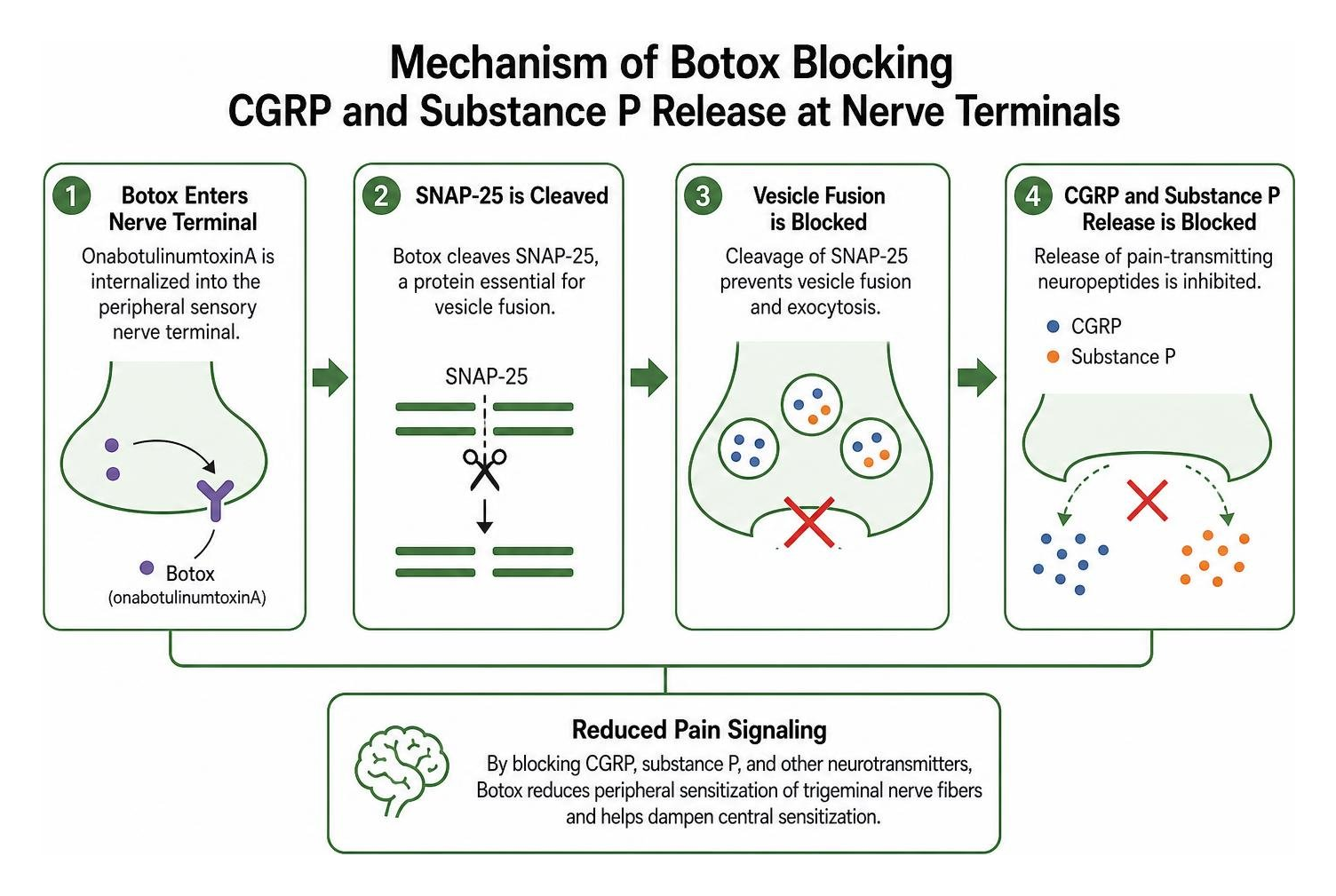
The way neurotoxins prevent headaches is distinct from how they smooth wrinkles. When injected into targeted pericranial muscles, onabotulinumtoxinA enters peripheral sensory nerve terminals. It cleaves SNAP-25, a crucial protein required for vesicle fusion, blocking the exocytosis of pain-transmitting neurochemicals (Escher et al., 2017).
By inhibiting the release of calcitonin gene-related peptide (CGRP), glutamate, and substance P, Botox reduces peripheral sensitization of trigeminal sensory nerve fibers. Over time, reducing peripheral pain inputs dampens central sensitization in the trigeminal nucleus caudalis, calming the hypersensitive brain pathways driving chronic attacks. To dive deeper into how neuromodulators interact with cellular receptors, explore the science of Botox.
How Botox Treatment Migraine Protocols Prevent Chronic Headaches
The clinical efficacy of Botox relies entirely on standard anatomical administration rather than arbitrary injection points. The FDA-approved PREEMPT (Phase III REsearch Evaluating Migraine Prophylaxis Therapy) paradigm outlines a fixed-site, fixed-dose intramuscular approach.
A standard session involves 155 units of onabotulinumtoxinA distributed across 31 specific injection sites spanning seven head and neck muscle groups. Clinicians can utilize an optional “follow-the-pain” strategy to deliver an additional 40 units across up to 8 specific sites (reaching a maximum dose of 195 units) if patients present with localized muscular tender points (Escher et al., 2017). This MUST be done by a medically licensed injector. Not all injectors are medically licensed, which is especially important when treating conditions like migraines. At Natura, we require all of our injectors to hold a medical license. For an in-depth breakdown of practical administration and expectations, review the clinical overview from Cleveland Clinic.
The seven primary muscle groups injected during every session include:
- Corrugators: 2 sites (10 units total)
- Procerus: 1 site (5 units)
- Frontalis: 4 sites (20 units total)
- Temporalis: 8 sites (40 units total, bilateral)
- Occipitalis: 6 sites (30 units total, bilateral)
- Cervical Paraspinal Muscle Group: 4 sites (20 units total, bilateral)
- Trapezius: 6 sites (30 units total, bilateral)
Understanding the Science Behind Botox Treatment Migraine Relief
The PREEMPT clinical trial program, involving 1,384 adult patients, demonstrated that onabotulinumtoxinA significantly reduces monthly headache days and migraine-specific days compared to placebo (Escher et al., 2017). Patients experienced improvements across multiple quality-of-life indices, such as the Headache Impact Test (HIT-6) and Migraine-Specific Quality of Life questionnaire (NBK565160).
Long-term registry studies, including the COMPEL study, demonstrated sustained clinical benefit over two years of ongoing care, with patients achieving an average reduction of over 10 headache days per month by week 108 (NBK565160). Real-world data confirm that reductions in headache frequency, severity, and acute pain medication intake remain stable across consecutive 12-week cycles (Escher et al., 2017).
While most individuals respond favorably, up to 10% of patients may experience primary or secondary treatment failure over extended periods. Clinical guidelines, such as those summarized in the NCBI clinical review report, recommend completing a minimum of two to three 12-week cycles before declaring a patient a non-responder, as neural desensitization is cumulative.
Comparative Efficacy: Botox Versus Oral Prophylactics
Before injectable neurotoxins, chronic migraine management depended heavily on daily oral medications, including topiramate, beta-blockers (propranolol), tricyclic antidepressants (amitriptyline), and anticonvulsants (divalproex sodium).
While oral preventives can be effective, they often carry high discontinuation rates due to systemic side effects like cognitive slowing, extreme fatigue, dry mouth, weight changes, and hypotension. In the head-to-head FORWARD trial comparing topiramate to onabotulinumtoxinA, Botox demonstrated superior tolerability: only 14.3% of patients in the Botox group discontinued treatment due to adverse events, compared to 80.3% in the topiramate cohort (NBK565160). Because Botox acts locally within head and neck tissue compartments, it avoids most systemic organ interactions.
Clinical Administration, Procedure Steps, and Safety
Prior to receiving injections, patients undergo a thorough clinical assessment to verify eligibility, screen for neuromuscular disorders, and rule out acute scalp infections. Preparing for a session is simple: avoid alcohol and blood-thinning supplements for 24 to 48 hours prior to minimize bruising, and arrive with clean hair free of heavy styling products.
The administration itself takes approximately 15 to 20 minutes. Using a sterile 30-gauge, 0.5-inch needle, the practitioner delivers 0.1 mL (5 units) per site. The sensation is typically described as a brief pinch or sting.
What to Expect During Your Botox Treatment Migraine Session
Following the 31 injections across the forehead, temples, back of the head, neck, and shoulders, patients can immediately resume most non-strenuous daily activities.
To support optimal product uptake and minimize complications:
- Remain upright for at least four hours following treatment.
- Avoid vigorous cardiovascular exercise or heavy weightlifting for 24 hours.
- Refrain from rubbing, massaging, or applying firm pressure to the injection sites.
- Postpone chemical hair dyes, bleaching, or tight headbands for 24 to 48 hours.
For comprehensive post-treatment instructions, review our essential Botox recovery tips.
Side Effects, Safety Profiles, and Contraindications
OnabotulinumtoxinA is generally well tolerated. Most side effects are mild, localized, and resolve on their own within several days to a few weeks.
In clinical trials, the most commonly reported adverse events (versus placebo) included (Escher et al., 2017):
- Neck pain: 9% vs. 3%
- Headache exacerbation: 5% vs. 3%
- Eyelid ptosis (drooping): 4% vs. <1%
- Muscular weakness: 4% vs. <1%
- Injection site tenderness/bruising: 2.1%
Like all botulinum toxin formulations, the prescribing information includes an FDA boxed warning regarding the potential for distant spread of toxin effects, which can cause symptoms such as generalized muscle weakness, dysphagia (swallowing difficulty), or breathing problems hours to weeks after administration (NBK565160). These reactions are exceedingly rare at the doses used for chronic migraine and are more common when treating conditions requiring higher systemic doses, such as limb spasticity. Full safety and contraindication details are available in the FDA safety data.
Frequently Asked Questions About Botox for Migraines
How long does it take for Botox to start working for chronic migraines?
Unlike acute abortive medications that stop an active headache within hours, onabotulinumtoxinA is a preventive treatment. Initial reductions in headache frequency typically begin within 10 to 14 days after the first session. However, the maximum clinical benefit usually emerges after two to three treatment cycles (administered 12 weeks apart). Maintaining a detailed daily headache diary is the best way to track reductions in headache frequency, intensity, and duration.
Can cosmetic Botox and migraine injections be administered together?
Yes, but coordination is essential. Because the migraine protocol already includes injections into the frontalis, corrugators, and procerus muscles, adding cosmetic units to those same areas can lead to muscle over-weakening, brow heaviness, or eyelid ptosis. If you receive aesthetic neuromodulators, notify your clinician so overall dosage can be tracked safely across our range of professional injectables.
What happens if I miss a 12-week Botox treatment cycle?
The therapeutic effects of onabotulinumtoxin gradually wear off over 10 to 12 weeks as nerve terminals regenerate SNAP-25 and resume normal neurotransmitter release. If you delay or miss your 12-week maintenance appointment, you may experience a resurgence of headache days and migraine intensity. Maintaining a consistent calendar schedule helps keep sensory nerves desensitized. Have additional questions about scheduling? Visit our patient FAQs.
Conclusion
Managing chronic migraine requires a structured, evidence-based preventive strategy. By interrupting peripheral and central pain signaling pathways, onabotulinumtoxin offers long-term relief for adults struggling with frequent, debilitating headaches. When combined with proper lifestyle adjustments, triggers management, and specialist oversight, this therapeutic protocol can help you regain control over your daily routine.
At Natura Med Spa & IV Bar, we provide supportive wellness services across our locations in Denver, and Aurora, Colorado. If you are exploring neuromodulator therapies, schedule one of our personalized Botox injection consultations today.
Scientific References
Escher CM, Paracka L, Dressler D, Kollewe K. “Botulinum toxin in the management of chronic migraine: clinical evidence and experience..” Therapeutic advances in neurological disorders, 2017. PMCID PMC5367647. “INTRODUCTION.” Canadian Agency for Drugs and Technologies in Health, 2015. NBK344306. “Executive Summary.” Canadian Agency for Drugs and Technologies in Health, 2019. NBK565160.